










The Science of Silence: Unlocking Secrets in the Vacuum of Space
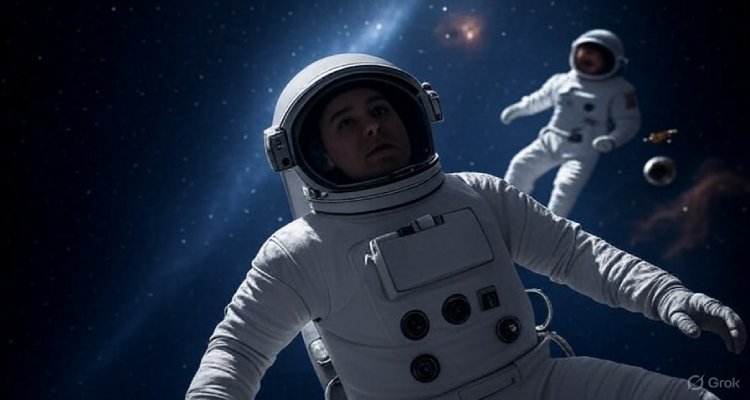
Exploring the science behind the silence of space—how the vacuum unveils cosmic secrets, from gravitational waves to quantum noise suppression.
Introduction: When Silence Speaks Volumes
In space, no one can hear you scream—not because the sound is absent, but because the medium for carrying it is. This profound silence isn’t just eerie—it’s essential. In recent years, scientists have discovered that this quietude holds the key to decoding the mysteries of the universe. From the faint whispers of gravitational waves to the quantum-level fluctuations detectable only in complete silence, the vacuum of space is not empty—it’s revelatory.
The Quiet Cosmos: A Background
Outer space is a vacuum—devoid of air, matter, and any medium for sound to travel. Unlike on Earth, where sound waves propagate through molecules in the air, water, or solids, space offers no such channel. While this may appear to be a sensory void, it’s precisely this absence of interference that has opened new doors for space science.
Before Einstein, space was assumed to be an ethereal nothingness. But post-relativity and with the advent of quantum field theory, scientists now understand that the vacuum is alive with activity—fields, particles flickering in and out of existence, and minute distortions in spacetime itself. This new understanding of silence has transformed it into a powerful observational tool.
What Silence Reveals: Groundbreaking Discoveries in the Void
1. Gravitational Waves: Listening to the Universe’s Echo
In 2015, LIGO (Laser Interferometer Gravitational-Wave Observatory) made history by detecting gravitational waves—ripples in spacetime created by colossal cosmic events like black hole mergers. But to hear these faint signals, LIGO needed the quietest conditions imaginable. Even a truck passing miles away could distort results. By simulating the vacuum of space in its laser chambers, LIGO harnessed the power of silence to make one of the most significant astrophysical discoveries of our time.
2. Quantum Silence: Suppressing Noise to Find Truth
At quantum scales, even the tiniest thermal vibrations can drown out vital information. In space-based experiments like the European Space Agency’s LISA Pathfinder, researchers tested ultra-quiet environments to detect gravitational disturbances. The extreme silence allowed them to measure phenomena so delicate that they’d be impossible to observe on Earth.
3. Cosmic Microwave Background (CMB): Fossil Light in a Silent Sky
The CMB is the afterglow of the Big Bang—a soft, nearly uniform radiation field present throughout the universe. It was discovered in the mid-20th century when researchers unintentionally stumbled upon a persistent noise in their radio antennas. Today, satellites like Planck and COBE map the CMB from the quiet of space, offering a snapshot of the universe when it was just 380,000 years old.
Expert Insights: What Scientists Are Saying
“Space isn’t empty—it’s the cleanest laboratory we have,” says Dr. Tara Michaels, an astrophysicist at NASA’s Goddard Space Flight Center. “The vacuum allows us to measure phenomena that would otherwise be lost in Earth’s noise.”
Dr. Anil Sharma, a quantum physicist at the Max Planck Institute, adds, “We’re now building quantum sensors that thrive in low-noise environments. The silence of space is an asset, not an obstacle.”
Public curiosity is also on the rise. Google searches for “gravitational waves” and “quantum vacuum” have skyrocketed in recent years, revealing an appetite for understanding how the universe communicates through its quietest moments.
The Implications: A Quieter Future for Deeper Discovery
Space-Based Observatories
Future missions like LISA (Laser Interferometer Space Antenna) and NASA’s Nancy Grace Roman Space Telescope are being designed with this silence in mind. Floating in space, free from Earthly interference, these instruments will record signals with unparalleled precision.
Interstellar Messaging
Understanding the medium of silence has implications for how we might communicate across space. If sound can’t travel, signals must—be it through light, radio, or gravitational wave messaging. In a universe that doesn’t favor noise, our future in space depends on mastering the art of silence.
Deep Space Exploration
As we push toward crewed missions to Mars and beyond, our understanding of how silence affects sensors, communication systems, and even human psychology will become crucial. Soundless environments might also play a role in preserving delicate scientific experiments during long-duration missions.
Conclusion: The Voice Within the Void
What we once saw as absence, we now see as potential. The vacuum of space—once thought to be inert—is now known as a stage for the most profound physical processes. From gravitational waves to quantum phenomena, silence has become a source of truth, a listening chamber for the cosmos.
As our instruments grow more sensitive and our reach into the stars extends further, the science of silence will guide us. It reminds us that sometimes, the loudest truths are the ones whispered in the dark.
Disclaimer: This article is for informational purposes only and reflects current scientific research as of the time of publication. Opinions quoted are those of the respective experts and do not represent official positions of NASA or ESA.