










The Invisible Market Moving Trillions Without Human Approval
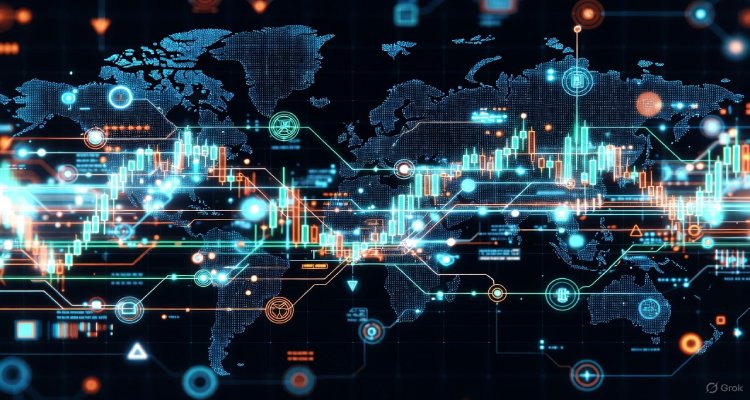
A deep dive into the hidden algorithmic market that moves trillions without human approval — exploring its rise, risks, global impact, and uncertain future.
Introduction: A Market No Human Can See
At 3:14 a.m. in Singapore, billions of dollars changed hands on global exchanges — and not a single human clicked “buy.”
What looks like silence in trading floors across New York, Tokyo, and Frankfurt is, in reality, the busiest time for the world’s fastest-growing financial force: the invisible market. This shadowlike ecosystem of autonomous algorithms, data-driven bots, and self-executing contracts is now moving trillions of dollars daily, often without any direct human approval.
For many, it has become the heart of modern finance. For others, it represents an economic fault line—quiet until the day it shakes the world.
Context & Background: How Finance Became Automated
A decade ago, algorithmic trading was just another Wall Street experiment. Today, nearly every major financial system—from commodities and cryptocurrencies to sovereign bonds—relies on machine-driven decision-making.
Three major developments enabled this transformation:
1. Speed Became More Valuable Than Strategy
High-frequency trading (HFT) firms invested billions in fiber-optic cables, microwave towers, and low-latency hardware.
In milliseconds, algorithms began outperforming even the most experienced traders.
2. Markets Became Too Complex for Humans
Globalized derivatives, 24/7 crypto exchanges, and fragmented digital marketplaces created a world no single person could watch.
Machines filled the gap—efficiently, relentlessly, and without sleep.
3. AI Became Self-Steering
The introduction of self-learning financial models allowed algorithms not just to follow rules but to create them.
Here, human approval became optional.
This evolution built a new kind of marketplace—one that humans designed but no longer fully control.
Main Developments: A Trillion-Dollar System Running on Autopilot
Today’s invisible market operates through interconnected layers:
Algorithmic Traders
Bots scan global prices, news sentiment, economic indicators, and even satellite imagery to predict micro-movements.
These systems initiate trades faster than a human eye can blink—literally.
Smart Contracts and Decentralized Finance
DeFi protocols automatically lend, borrow, liquidate, or rebalance portfolios using preset logic.
If collateral falls, positions are liquidated instantly—no phone calls, no approvals, no negotiations.
Autonomous Asset Management
AI-powered funds now manage pension accounts, sovereign wealth strategies, and retail investor portfolios.
They rebalance trillions in assets without waiting for human oversight.
The result is a financial engine humming beneath the surface—swift, invisible, and largely unregulated.
Expert Insight & Public Reaction
Financial and technology analysts are divided.
“We’ve created markets that operate faster than we can comprehend.”
— Dr. Leena Hoffmann, Financial Systems Researcher
Hoffmann warns that machine-driven markets may be efficient, but they are also opaque, making it harder for regulators to identify market distortions or prevent systemic risk.
“Humans are the bottleneck. Algorithms remove emotion and error.”
— Bryce Allen, Quantitative Analyst
Supporters argue that automated markets eliminate irrational decisions and panic selling, creating smoother price discovery.
Public Sentiment: A Mix of Awe and Anxiety
Retail investors feel increasingly disconnected from a system they once believed was human-driven.
Online investor forums frequently describe today’s market as “rigged by machines” or “unpredictable.”
While that may not be technically true, the perception underscores a widening trust gap.
Impact & Implications: What Happens When Markets Become Autonomous?
1. Market Stability vs. Flash Crashes
Although automation reduces human emotion, it can also amplify volatility.
History has seen sudden price collapses triggered by runaway algorithms—events that lasted minutes but wiped out billions.
2. Regulatory Blind Spots
Governments struggle to regulate systems that operate faster than legislation can adapt.
Who is responsible when an autonomous model misbehaves—the developer, the investor, or the AI itself?
3. Inequality Between Machine-Driven and Human-Driven Investors
Retail traders using mobile apps cannot compete with microsecond decision systems.
This growing imbalance raises concerns about fairness in global markets.
4. Dependence on Non-Human Infrastructure
If algorithms fail—or are targeted in a cyberattack—global financial stability could be shaken within seconds.
5. The Future of Work in Finance
As autonomous systems take over trading, risk assessment, and asset allocation, traditional finance roles may shrink.
New demand for AI auditors and algorithm ethics specialists, however, may rise.
In short: the invisible market is efficient, powerful, and unstoppable—but it carries enormous consequences.
Conclusion: A Market That Moves Without Us
The invisible market is no longer an experiment—it is the backbone of modern finance.
It moves trillions through unseen algorithms, challenges old assumptions about control, and raises profound questions about responsibility, fairness, and stability.
Whether it becomes the engine of economic progress or the catalyst for the next global crisis remains unclear.
But one thing is certain: the world’s most powerful market is one we can’t see — and no longer directly command.
Disclaimer : This article is for informational and educational purposes only. It does not constitute financial advice, investment guidance, or legal recommendations. Market behavior and technological systems may vary across regions and platforms.