










Samsung’s AI Chip Boom Powers Record Profit Surge
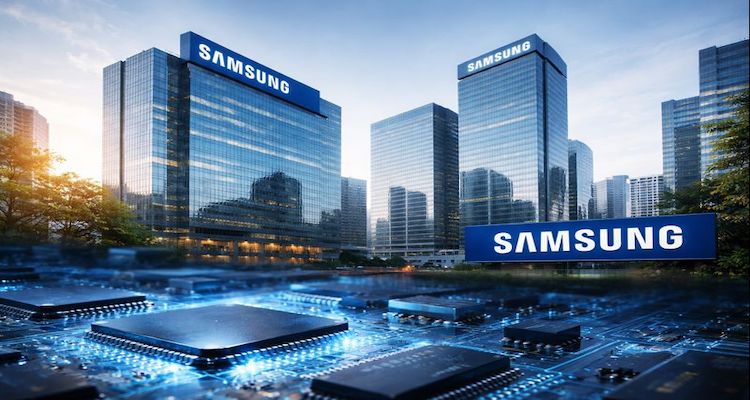
Samsung Electronics’ latest earnings outlook underscores how artificial intelligence is reshaping the global chip industry. A sharp rebound in memory prices, fueled by surging AI demand and limited supply, has pushed the world’s largest memory chipmaker to a historic profit milestone signaling a broader shift in semiconductor economics.
Samsung posts a historic profit forecast
Samsung Electronics said Thursday it expects its operating profit for the October–December quarter to triple from a year earlier, reaching a record high. The South Korean tech giant projected operating profit of about 20 trillion won ($13.8 billion), well above market expectations and a dramatic jump from 6.49 trillion won in the same period last year.
The figure surpasses Samsung’s previous quarterly record of 17.6 trillion won set in 2018, marking a pivotal moment after a prolonged downturn in the memory chip cycle.
Investors responded positively. Samsung shares rose 0.6% in early trading, touching an all-time high and extending a rally that has seen the stock gain roughly 155% over the past year.
AI demand reshapes the memory market
At the heart of Samsung’s resurgence is a sharp tightening in the global supply of conventional memory chips, particularly DRAM. These components are critical for servers, personal computers, and smartphones and increasingly indispensable for AI workloads.
As companies race to build AI infrastructure, demand for memory used in data centers has surged faster than manufacturers can expand capacity. The imbalance has sent chip prices soaring, reversing years of weak pricing power for memory makers.
According to data from market research firm TrendForce, contract prices for certain DRAM products jumped more than 300% in the fourth quarter compared with a year earlier. TrendForce expects prices to climb another 55% to 60% in the current quarter, underscoring how tight the market has become.
Industry leaders warn supply is lagging demand
Samsung is not alone in struggling to keep pace. Rivals such as SK Hynix and U.S.-based Micron Technology are also racing to expand fabrication capacity as orders pile up.
Speaking at the Consumer Electronics Show in Las Vegas, Nvidia chief executive Jensen Huang said the rise of what he described as “AI factories” is fundamentally changing the semiconductor landscape.
He noted that the world will need far more chip fabrication plants to meet demand, adding that conditions are unusually favorable for chipmakers as AI adoption accelerates across industries.
A booming DRAM market
The scale of the shift is striking. Macquarie Equity Research estimates that the global DRAM market could more than double to $311 billion by 2026, compared with last year. That would represent nearly six times the market’s size in 2023, reflecting how quickly AI-related demand is transforming memory economics.
DRAM chips play a crucial role in enabling fast data access and smooth performance in computing systems. As AI models grow larger and more complex, they require significantly more memory, amplifying demand across the supply chain.
Semiconductor division leads Samsung’s earnings
Samsung expects quarterly revenue to rise 23% from a year earlier to a record 93 trillion won, buoyed largely by its semiconductor business.
Analysts say memory chips will account for the majority of operating profit. NH Investment & Securities estimates Samsung’s chip division generated roughly 17 trillion won in operating profit during the quarter, dwarfing contributions from its other businesses.
Ryu Young-ho, a senior analyst at the firm, said strong memory pricing is likely to more than offset weaker growth in Samsung’s mobile division, which faces limits on how much it can raise smartphone prices without hurting demand.
Rising costs pose challenges for device makers
Despite the upbeat outlook, analysts caution that rapidly rising memory prices could create headwinds elsewhere in the tech ecosystem.
Higher component costs may squeeze margins for data center operators, PC makers, and smartphone manufacturers, potentially slowing demand if price increases are passed on to customers.
DB Securities analyst Seo Seung-yeon expects Samsung’s mobile division profit to decline year-on-year in the fourth quarter due to higher memory costs. In contrast, Samsung’s display business is forecast to perform strongly, supported by solid sales of Apple’s latest iPhone models.
Samsung co-CEO TM Roh acknowledged that higher memory prices were likely to have some impact. In comments to Reuters, he said the effect was “inevitable” and did not rule out the possibility of price adjustments across Samsung’s product lineup.
Optimism tempered by supply constraints
Most analysts remain broadly optimistic about Samsung’s earnings trajectory, arguing that memory undersupply could persist well into 2026. Global investment in data centers continues to expand, while new chip manufacturing capacity takes years to come online.
That dynamic gives leading memory makers pricing power rarely seen in the past decade. However, sustained price increases also raise the risk of demand destruction if customers begin to delay upgrades or seek alternatives.
For now, the balance appears to favor suppliers like Samsung, which benefit from scale, advanced manufacturing, and a diversified customer base.
Advanced memory seen as the next growth engine
Beyond conventional DRAM, Samsung is positioning itself for growth in high-bandwidth memory (HBM), a critical component for advanced AI processors.
Analysts expect Samsung’s HBM business to expand significantly in 2026, following a relatively modest contribution in 2025. Demand is rising from customers developing custom AI chips, including tensor processing units, and from expectations that Samsung could win a larger share of orders from Nvidia.
Samsung co-CEO Jun Young-hyun said recently that customers have responded positively to the company’s next-generation HBM4 products, signaling renewed confidence in Samsung’s competitiveness in advanced memory.
What comes next for Samsung
Samsung plans to release its full earnings report on January 29, including detailed results for each business division. Investors will be watching closely for guidance on memory pricing, capacity expansion, and progress in high-bandwidth memory.
The company’s record-breaking quarter highlights a broader reality: AI is no longer a niche driver of chip demand but a structural force reshaping the semiconductor industry.
For Samsung, the challenge now is sustaining momentum balancing aggressive investment with discipline, managing rising costs across its product lines, and maintaining leadership as competitors race to catch up.
(With inputs from Reuters.)
ALSO READ: UK Forces Platforms to Stop Sexual Image Abuse Online
Disclaimer:
The information presented in this article is based on publicly available sources, reports, and factual material available at the time of publication. While efforts are made to ensure accuracy, details may change as new information emerges. The content is provided for general informational purposes only, and readers are advised to verify facts independently where necessary.