










RBI Cuts Repo Rate to 5.25%: Borrowers Set to Benefit as Inflation Eases
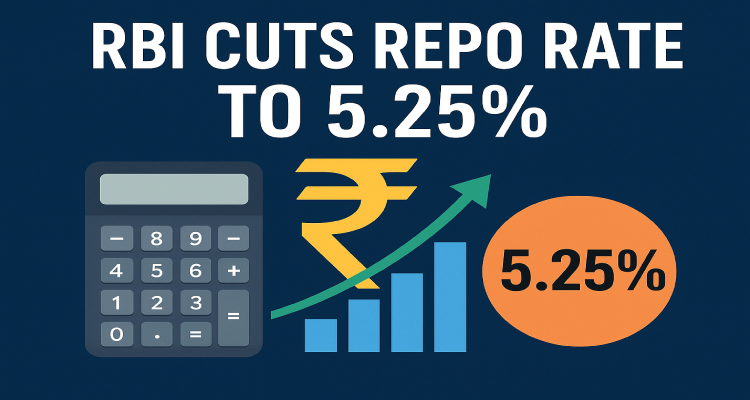
RBI cuts repo rate to 5.25% after six months, offering relief to borrowers. Here’s what the policy shift means for inflation, growth, and India’s credit market.
Introduction: A Surprise Thaw in India’s Rate Cycle
After months of monetary tightness, the Reserve Bank of India (RBI) delivered a widely anticipated yet pivotal decision on December 5—reducing the benchmark repo rate by 25 basis points to 5.25%. It was the first cut in half a year, signaling a shift toward supporting economic momentum as inflation gradually stabilizes. For millions of home, auto, and corporate borrowers, the move comes as welcome relief at a time of tightening household budgets and high borrowing costs.
Context & Background: A Gradual Pivot After a Year of Caution
The December announcement marks the fourth rate cut since February 2025, following reductions of 25 bps each in February and April and a steeper 50 bps cut in June. The central bank subsequently paused in August and October, even as analysts debated the timing of the next move amid cooling retail inflation.
At the heart of India’s monetary framework lies the repo rate—the rate at which RBI lends short-term funds to commercial banks. Often referred to as the economy’s benchmark interest rate, repo movements influence everything from EMIs and business loans to bank deposit rates. Its counterpart, the reverse repo rate, is the rate at which banks lend money to the RBI.
India’s monetary policy direction is shaped by the Monetary Policy Committee (MPC)—a six-member panel empowered under the amended Reserve Bank of India Act, 1934. Since the adoption of flexible inflation targeting in 2016, the MPC’s prime objective has been striking a balance between price stability and economic growth.
Main Developments: Why the Rate Cut Matters Now
Announcing the fifth bi-monthly monetary policy of the fiscal year, RBI Governor Sanjay Malhotra confirmed that the MPC voted unanimously to cut the repo rate by 25 bps while maintaining a neutral stance. This signals that the committee sees room to support growth without undermining its inflation mandate.
Key highlights from the announcement include:
- Repo rate reduced from 5.50% to 5.25%
- Neutral policy stance, keeping future rate movements data-driven
- Cooling retail inflation cited as a major factor
- Continued monitoring of global oil prices, supply chain risks, and domestic demand
For borrowers, the transmission of rate cuts typically flows gradually, but banks are expected to adjust lending rates soon. Home loan EMIs—particularly floating-rate loans—are poised to decline modestly in the coming quarters.
Expert Insight & Public Reaction: Analysts See Timely Course Correction
Economists and market watchers largely welcomed the move, calling it a calibrated response to evolving macroeconomic signals.
Raghav Sharma, Chief Economist at FinEdge Analytics, noted:
“The 25-bps cut reinforces the RBI’s confidence in the inflation trajectory. With consumption showing signs of fatigue, the timing is appropriate and should support credit demand in the upcoming quarters.”
On the banking side, lenders expect a steady uptick in retail borrowing. A senior public-sector bank official, requesting anonymity, said:
“After months of cautious lending, the cost of funds will ease slightly. We anticipate more activity in home and auto loans as consumer sentiment improves.”
Meanwhile, borrowers expressed palpable relief on social media and financial forums. For many households, even a small EMI reduction provides vital cushion amid rising living costs.
Impact & Implications: What the Rate Cut Means for India’s Economy
1. Relief for Borrowers and Businesses
Lower borrowing costs will stimulate loan demand, especially in housing and MSME sectors, which have been sensitive to rate fluctuations. Corporates may also find it easier to refinance debt.
2. A Boost to Consumption and Investment
As EMIs ease, discretionary income rises—unlocking potential improvements in consumption, a key growth engine for India.
3. Inflation Outlook Remains Central
Despite easing inflation, RBI remains cautious. Any surge in food or fuel prices, global instability, or supply disruptions could influence future rate decisions.
4. MPC’s Role in Forward Guidance
With three RBI-appointed members and three government-appointed experts, the MPC’s structure promotes diverse expertise and transparency. The committee must meet at least four times a year, and its resolutions continue to shape India’s policy credibility.
5. Monetary Policy Framework: A Broader Mandate
Under the flexible inflation-targeting system, the government—after consulting with RBI—sets inflation targets every five years. Maintaining price stability remains the primary goal, but growth considerations are increasingly critical in a rapidly changing global economy.
Conclusion: A Turning Point for Borrowers and Markets
The RBI’s decision to cut the repo rate to 5.25% reflects cautious optimism amid improving inflation conditions and the need to support economic momentum. As lending rates begin to adjust, households and businesses may find some breathing space. However, future policy direction will remain tied to the delicate balance between inflation control and growth support.
With global uncertainties still looming, the path ahead will be shaped as much by data as by the MPC’s evolving assessment of domestic and international risks. For now, borrowers can look forward to a lighter EMI burden—and an economy recalibrating itself for sustained expansion.
Disclaimer :This article is for informational and educational purposes only. It does not constitute financial advice. Readers should consult a qualified financial advisor before making decisions related to loans or investments.