










Quantum Computing Explained—And Why It Matters Now
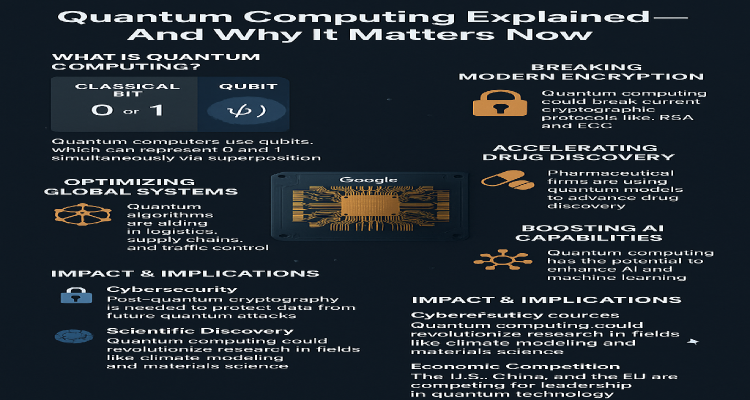
Quantum computing is no longer theoretical—it’s redefining science, cybersecurity, and AI. Here’s what it means and why the world should pay attention.
Introduction: The Quantum Leap We’ve Been Waiting For
Imagine a computer so powerful that it could solve in seconds what today’s supercomputers would take millennia to calculate. That’s not science fiction anymore—it’s quantum computing, and it’s rapidly moving from the lab into the real world. As nations race to harness its power and tech giants pour billions into development, the stakes—and opportunities—have never been higher.
Context & Background: What Is Quantum Computing, Exactly?
Traditional computers use bits, which can represent a 0 or a 1. Quantum computers, on the other hand, use quantum bits or “qubits.” Unlike classical bits, qubits can exist in multiple states at once, thanks to principles like superposition and entanglement—concepts rooted in quantum physics.
This allows quantum computers to process an immense number of computations simultaneously. For instance, where a classical computer would have to test solutions one by one, a quantum computer can analyze countless possibilities in parallel.
Quantum computing was once the domain of theorists and physicists, but breakthroughs over the last decade—particularly by IBM, Google, and startups like IonQ and Rigetti—have moved the field into a more practical, applied phase.
Main Developments: Why It Matters in 2025
1. Breaking Modern Encryption
Quantum computing has the potential to render current encryption protocols, like RSA and ECC, obsolete. These systems depend on the difficulty of factoring large numbers or solving discrete logarithms—tasks that are practically impossible for classical computers, but trivial for powerful quantum systems.
That’s why organizations like NIST (National Institute of Standards and Technology) are already working on post-quantum cryptography standards to future-proof digital security.
2. Accelerating Drug Discovery
Pharmaceutical companies are investing in quantum models to simulate molecules with unmatched accuracy. Pfizer, Roche, and Merck have partnered with quantum startups to explore how qubits can speed up drug discovery, reduce trial-and-error, and design novel therapies faster than ever.
3. Optimizing Global Systems
Quantum algorithms are being tested for optimizing supply chains, logistics, and even air traffic control. Companies like Volkswagen and Airbus are already running pilot projects using quantum-inspired solutions.
4. Boosting AI Capabilities
AI models could also benefit from quantum computing by enabling faster training, better optimization, and solving complex data problems like pattern recognition or natural language processing in entirely new ways.
Expert Insight and Public Reaction
Dr. Michelle Simmons, quantum physicist and founder of Silicon Quantum Computing, says, “We’re at the point where quantum computing is transitioning from pure research to engineering. It’s like the dawn of classical computing in the 1940s—only this time, the revolution will move faster.”
Public sentiment is split. While some view quantum computing as a technological messiah, others fear its disruptive potential—especially regarding digital privacy. Tech ethicists have raised alarms about potential misuse and the need for global governance frameworks before full-scale deployment.
Impact & Implications: Who’s Affected and What’s Next?
Cybersecurity
Governments and financial institutions must prepare for the “quantum apocalypse”—a scenario where encrypted data stored today could be decrypted once quantum machines become powerful enough. The need for quantum-safe encryption is urgent.
Scientific Discovery
Fields like climate modeling, materials science, and astrophysics will benefit from quantum-enhanced simulations, allowing researchers to solve problems that were previously computationally impossible.
Economic Competition
The US, China, and the EU are all in a high-stakes race to dominate quantum technology. The country or coalition that succeeds may wield not only economic influence but also strategic cybersecurity superiority.
Conclusion: Quantum’s Tipping Point Is Now
Quantum computing is no longer an academic experiment. Its real-world implications—from medicine to national defense—are already unfolding. The next few years will determine not just who leads this quantum race, but how responsibly the technology is governed and applied.
As the field accelerates, awareness, education, and international cooperation will be key to ensuring that this transformative power benefits all—and not just a few.
Disclaimer: This article is for informational purposes only and reflects current trends and expert insights as of August 2025. Quantum computing is an evolving field, and developments may occur that alter projections or implications discussed here.