





President Murmu Presents Pradhan Mantri Rashtriya Bal Puraskar to 20 Children on Veer Bal Diwas
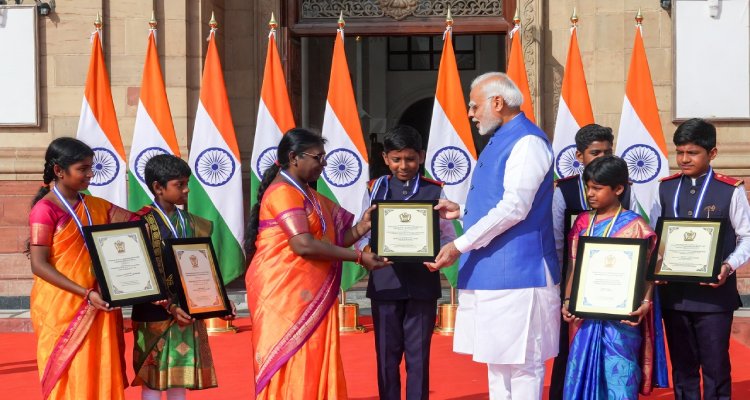
President Droupadi Murmu presents Pradhan Mantri Rashtriya Bal Puraskar to 20 children on Veer Bal Diwas, honouring courage, service, and excellence.
Introduction: Honouring Courage That Begins Young
On December 26, as India paused to remember one of the most powerful stories of sacrifice in its history, President Droupadi Murmu presented the Pradhan Mantri Rashtriya Bal Puraskar (PMRBP) to 20 exceptional children from across the country. The ceremony, held on Veer Bal Diwas, went beyond celebration—it reaffirmed a national belief that courage, innovation, and service can begin at a very young age.
From acts of bravery to achievements in science, sports, social service, and culture, the young awardees represented a generation that is not waiting for adulthood to make an impact. The awards, India’s highest civilian honour for children, symbolized both recognition and responsibility—acknowledging achievements while inspiring millions of young Indians watching from afar.
Context & Background: Why December 26 Matters
Veer Bal Diwas is observed every year on December 26 by the Ministry of Women and Child Development. The day commemorates the martyrdom of Sahibzada Zorawar Singh and Sahibzada Fateh Singh, the younger sons of Guru Gobind Singh, the tenth Sikh Guru.
A Defining Chapter in Indian History
During the conflict between Guru Gobind Singh and the Mughal Emperor Aurangzeb, the Guru and his family faced relentless persecution. After vacating Qila Shri Anandgarh Sahib, Guru Gobind Singh and his family attempted to cross the swollen Sirsa River, where tragedy struck. His mother, Mata Gujri, and the two younger Sahibzadas were separated from the rest of the family.
They were captured and handed over to Wazir Khan, the Nawab of Sirhind, and confined at Thanda Burj (the Cold Tower). Despite their young age, Sahibzada Zorawar Singh and Sahibzada Fateh Singh refused to abandon their faith. As punishment, they were bricked alive, a brutal act carried out at what is now known as Fatehgarh Sahib. Upon learning of her grandsons’ martyrdom, Mata Gujri also collapsed and passed away.
This sacrifice—made by children who stood unwavering in the face of death—forms the moral foundation of Veer Bal Diwas. The day seeks not only to remember history but to instill the values of courage, sacrifice, and moral conviction in today’s youth.
Main Developments: Celebrating Young Achievers of Modern India
Against this solemn historical backdrop, President Murmu conferred the Pradhan Mantri Rashtriya Bal Puraskar on 20 children who have demonstrated extraordinary commitment and excellence in their respective fields.
What Is the Pradhan Mantri Rashtriya Bal Puraskar?
The Government of India has recognized children’s achievements for decades through various national awards. However, during 2017–18, these awards were streamlined and unified under a single umbrella: the Pradhan Mantri Rashtriya Bal Puraskar.
The award system evolved from earlier honours such as:
- National Child Award for Exceptional Achievement (since 1996)
- National Child Welfare Award (individual and institutional, since 1979)
- Rajiv Gandhi Manav Sewa Award (since 1994)
Under the restructured framework, the awards were categorized as:
- Bal Shakti Puraskar
- Bal Kalyan Puraskar
In 2022, the Bal Shakti Puraskar category was fully subsumed under PMRBP, strengthening its identity as a single, prestigious civilian honour for children.
Categories of Excellence
The Pradhan Mantri Rashtriya Bal Puraskar honours achievements across six key areas:
- Bravery
- Social Service
- Environment
- Sports
- Art & Culture
- Science & Technology
A maximum of 25 awards are conferred each year, though the committee may relax this limit in exceptional cases. Each recipient receives a medal and a certificate, symbolizing national recognition at the highest level.
Expert Insight & Public Sentiment: A Message Beyond Awards
Educators, child development experts, and policymakers widely view the PMRBP as more than a ceremonial honour. It is seen as a nation-building instrument—one that reshapes how society views children, not as future contributors alone, but as active changemakers of the present.
Public reaction to the ceremony on Veer Bal Diwas reflected deep emotional resonance. Many observers noted the symbolic connection between the historical bravery of the Sahibzadas and the modern courage of today’s awardees. While the contexts differ, the underlying values—fearlessness, integrity, and service—remain timeless.
Parents and teachers often highlight that national recognition at such a young age builds confidence, nurtures discipline, and encourages lifelong commitment to excellence.
Impact & Implications: Shaping India’s Next Generation
The impact of the Pradhan Mantri Rashtriya Bal Puraskar extends far beyond the award ceremony. For the recipients, it opens doors to mentorship, platforms, and opportunities that might otherwise take years to access. For society, it sends a powerful message: age is not a barrier to leadership or contribution.
Encouraging Purpose-Driven Youth
By honouring sustained achievements rather than one-off accomplishments, the award emphasizes consistency, passion, and long-term commitment. The eligibility criteria—requiring recipients to be Indian citizens aged between 5 and 18 years, with proven work over time—ensures credibility and depth.
The rigorous selection process, involving screening committees and a National Selection Committee, further strengthens trust in the institution.
At a broader level, the awards encourage children across India to pursue meaningful paths—whether through innovation, environmental action, cultural preservation, or social reform—knowing their efforts can gain national recognition.
Conclusion: Where History and the Future Converge
The presentation of the Pradhan Mantri Rashtriya Bal Puraskar on Veer Bal Diwas is a powerful convergence of memory and momentum. By honouring the sacrifice of Sahibzada Zorawar Singh and Sahibzada Fateh Singh, India remembers the courage that shaped its moral identity. By celebrating today’s young achievers, the nation invests in a future driven by the same values.
As President Murmu honoured the 20 children, the message was unmistakable: the spirit of bravery and service that once defined India’s past continues to thrive in its youngest citizens. In recognizing them, the nation does more than applaud achievement—it renews its faith in the generation that will shape tomorrow.
The information presented in this article is based on publicly available sources, reports, and factual material available at the time of publication. While efforts are made to ensure accuracy, details may change as new information emerges. The content is provided for general informational purposes only, and readers are advised to verify facts independently where necessary.