









Inside the Lab Studying the Planet’s Next Major Mutation
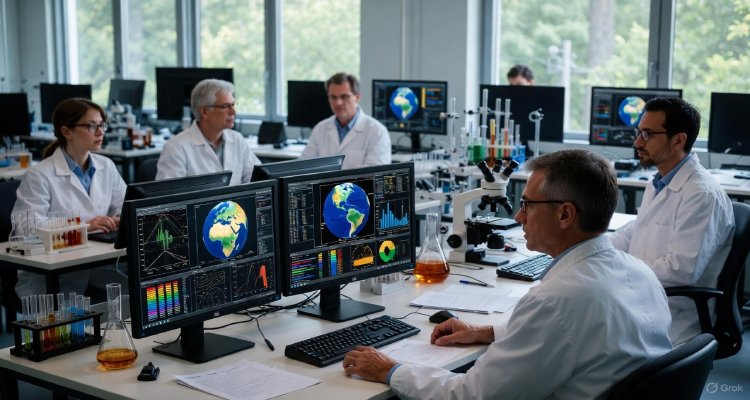
Scientists inside a cutting-edge lab are studying how climate stress and human activity may be pushing Earth into its next major planetary transformation.
Introduction: When Earth Becomes the Experiment
Deep inside a fortified research facility, far from political slogans and climate conference stages, scientists are running simulations that suggest Earth may be on the brink of its next major transformation. Not a slow shift measured over millennia—but a rapid planetary mutation unfolding within decades. This is not science fiction. It is the quiet, data-driven work of a growing network of labs studying how climate stress, human activity, and biological feedback loops are reshaping the planet into something fundamentally new.
What they are discovering challenges long-held assumptions about stability, recovery, and humanity’s role in Earth’s future.
Context & Background: A Planet Under Accelerated Stress
For most of its 4.5-billion-year history, Earth evolved gradually, punctuated by rare but dramatic upheavals—ice ages, mass extinctions, and atmospheric revolutions. Today, researchers argue the planet has entered a different phase altogether: a period of compressed change, where geological, biological, and atmospheric systems are shifting simultaneously.
The lab at the center of this research was formed not to study climate change alone, but planetary behavior—how Earth reacts when multiple thresholds are crossed at once. Rising global temperatures, biodiversity loss, ocean acidification, microplastic saturation, and atmospheric chemical changes are no longer isolated variables. They are interacting, amplifying one another in ways traditional climate models failed to predict.
This convergence has led scientists to ask a once-unthinkable question: Is Earth mutating into a new functional state?
Main Developments: Modeling Earth’s Next Phase
Inside the lab, researchers rely on advanced Earth-system simulations that integrate climate physics, biological evolution, ocean chemistry, and human industrial impact. Their findings point to several emerging patterns.
First, ecosystems are no longer merely adapting—they are reorganizing. Forests are transforming into grasslands, coral reefs into algae-dominated systems, and polar environments into seasonally ice-free zones. These shifts are happening faster than species can evolve, forcing abrupt collapses and replacements.
Second, atmospheric behavior is becoming less predictable. Jet streams are weakening, heat domes are persisting longer, and extreme weather events are clustering rather than dispersing. According to lab data, Earth’s climate is moving toward a new equilibrium, but one that looks nothing like the conditions under which modern civilization developed.
Perhaps most striking is the evidence that human systems—cities, agriculture, supply chains—are now embedded within Earth’s natural feedback loops. In effect, civilization itself has become a planetary force, altering how Earth regulates heat, water, and carbon.
Expert Insight: “The Planet Is Responding”
“The planet is not breaking—it’s responding,” said one senior Earth systems scientist affiliated with the lab. “What we’re seeing is Earth recalibrating under pressure. The problem is that this recalibration is not optimized for us.”
Researchers emphasize that the term mutation does not imply intent or consciousness. Instead, it reflects a systems-level transition, similar to past planetary shifts—only faster and more entangled with human activity.
Public reaction to these findings has been mixed. Some policymakers view the research as alarmist. Others see it as overdue realism. Environmental advocates argue the lab’s work confirms what frontline communities have experienced for years: climate change is no longer a future threat, but a present restructuring of reality.
Impact & Implications: Who Lives in the New Earth?
If the lab’s projections are accurate, the implications are profound. Agriculture zones may permanently shift, making some regions uninhabitable while opening others. Coastal cities face not just rising seas, but destabilized weather systems that challenge infrastructure design. Biodiversity loss could accelerate as ecosystems fail to recover between disruptions.
Yet the research also suggests a narrow window of influence remains. While Earth’s mutation may be inevitable, its severity is not fully locked in. Human decisions over the next two decades—energy use, land management, consumption patterns—could determine whether the planet’s next state is merely harsher, or fundamentally hostile to complex life.
The lab’s work is now being quietly referenced by urban planners, defense analysts, and food security experts. The question is no longer how to prevent change, but how to live through it.
Conclusion: Witnessing a Planet in Transition
Inside the lab, there is no panic—only urgency. Scientists understand that Earth has survived far worse than humanity. The uncertainty lies in whether humanity can survive the Earth it is helping to create.
The planet’s next major mutation will not arrive with a single disaster or headline. It is unfolding already, in heatwaves that linger, species that vanish silently, and systems that no longer behave as expected. The lab is not predicting the end of the world—but documenting the birth of a different one.
Disclaimer :This article is a journalistic interpretation based solely on the provided headline. It does not reference or reproduce any specific existing study, institution, or previously published report.