










India Launches ‘Operation Sagar Bandhu’ to Assist Sri Lanka After Cyclone Ditwah
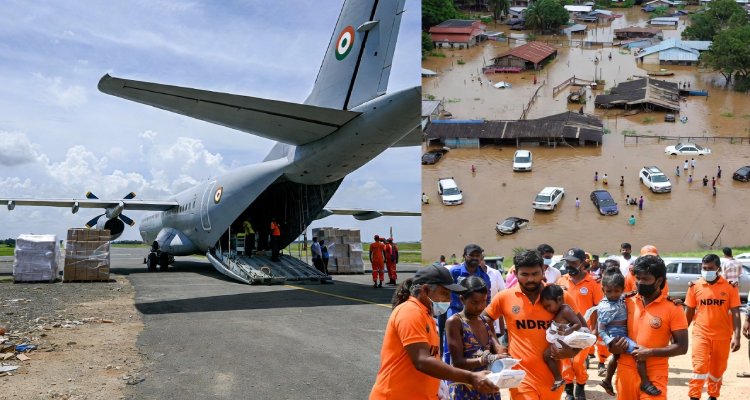
India has launched ‘Operation Sagar Bandhu’ to support Sri Lanka after Cyclone Ditwah triggered catastrophic floods, landslides, and mass displacement.
Introduction: A Nation Drowned, A Neighbor Responds
As Sri Lanka reels from one of its most devastating natural disasters in two decades, India has stepped in as the first responder—launching Operation Sagar Bandhu, a major humanitarian and disaster-relief mission. Cyclone Ditwah, which unleashed historic floods and landslides across the island nation, has left entire communities submerged, thousands displaced, and emergency systems overwhelmed. India’s swift deployment of aircraft, ships, and elite rescue teams marks one of the largest cross-border relief efforts in the region this year.
Context & Background: Cyclone Ditwah’s Path of Destruction
Cyclone Ditwah made landfall on November 28, carving a destructive trail through Sri Lanka before looping back over the Bay of Bengal. What followed was a deluge rarely seen since the early 2000s—weeks of uninterrupted rain that swallowed towns, triggered massive landslides, and pushed major rivers beyond breaking point.
Nearly one million people have been affected. More than 400 individuals are reported dead or missing. And with roads washed away, bridges destroyed, and power networks crippled, the country now faces a layered humanitarian crisis.
Hardest-hit districts include:
- Gampaha, Colombo, Puttalam, Mannar
- Eastern regions: Trincomalee and Batticaloa
- Central hills: Kandy, Badulla, and Matale, where deadly landslides have buried villages and cut off access entirely
With over 180,000 evacuees sheltering in more than 1,000 government-run centers, Sri Lanka’s disaster-response infrastructure has reached its limit—prompting India to activate its regional relief framework.
Main Developments: Inside ‘Operation Sagar Bandhu’
India Mobilizes Air, Sea, and Ground Assets
Under Operation Sagar Bandhu, India has intensified humanitarian assistance through a coordinated air-sea deployment:
- Two Indian Air Force aircraft, a C-130J and an IL-76, landed in Colombo carrying over 21 tonnes of relief material.
- 80 National Disaster Response Force (NDRF) personnel—highly trained in flood rescue, deep-terrain operations, and medical emergencies—were immediately dispatched to Puttalam and Badulla.
- Chetak helicopters from INS Vikrant airlifted stranded villagers to safety.
- IAF helicopters conducted high-risk search-and-rescue missions in Kotmale, a mountainous region cut off by unrelenting landslides.
The Kotmale operation, carried out in coordination with Sri Lankan authorities, involved rescuing individuals trapped in isolated pockets where mudslides have made roads impassable for days.
A Regional First-Responder in Action
India’s role builds on its long-standing “Security and Growth for All in the Region (SAGAR)” doctrine. Through past operations—Sagar-I, Sagar-II, and assistance to Madagascar, Maldives, and Mozambique—India has positioned itself as a reliable partner during climate-induced emergencies.
Operation Sagar Bandhu reaffirms that commitment.
Homes Destroyed, Infrastructure Shattered
Initial ground assessments in Sri Lanka paint a sobering picture:
- 15,000+ homes destroyed; thousands more damaged
- 200+ roads rendered unusable
- At least 10 bridges collapsed or severely weakened
- Rail lines and parts of the national power grid disrupted
- Kelani River flooding continues to submerge Colombo’s outskirts
- Severe communication outages in the North, including Jaffna, where entire villages remain isolated
- Clean water shortages escalating across multiple districts
The flooding of agricultural land and damage to food warehouses have added a new threat: looming food insecurity. With key supply routes severed, shortages and price spikes are expected in the coming weeks.
The World Health Organization has also issued a warning, noting that post-flood conditions dramatically increase the risk of water-borne, vector-borne, and food-borne diseases, including dengue and cholera.
Expert Insight & Public Reaction
Disaster-response analysts have praised India’s swift deployment, emphasizing the critical timing.
“Every hour counts in a crisis of this scale. India’s rapid airlift of medical teams and supplies is likely to save hundreds of lives,”
says Dr. Meera Liyanage, a Colombo-based disaster-risk researcher.
Local residents, meanwhile, describe scenes of chaos and gratitude. Social media is flooded with photos from evacuation centers—children receiving food packets, elderly survivors being airlifted, and NDRF teams navigating knee-deep mud in remote hamlets.
Impact & Implications: What Happens Next?
The next phase of Operation Sagar Bandhu is expected to prioritize:
- Restoring connectivity in landslide-hit central districts
- Reinforcing Sri Lanka’s medical response, especially for waterborne outbreaks
- Delivering additional relief materials, including water purification units and portable shelters
- Long-term rehabilitation, in coordination with Sri Lanka’s Disaster Management Centre
For Sri Lanka, the road to recovery will be long. Rebuilding homes, restoring critical infrastructure, and addressing food shortages may take months. For India, the operation strengthens bilateral ties and reinforces its role as a humanitarian anchor in the Indian Ocean.
Conclusion: A Crisis Met With Compassion
Cyclone Ditwah has tested Sri Lanka’s resilience in the harshest way—flattening homes, isolating villages, and pushing emergency resources to a breaking point. Yet, amid devastation, the region has witnessed a powerful reminder of solidarity. India’s Operation Sagar Bandhu stands as a testament to neighborly commitment, timely intervention, and the enduring belief that in moments of crisis, cooperation can mean the difference between loss and survival.
As search-and-rescue operations continue and new challenges emerge, India’s assistance will play a pivotal role in helping Sri Lanka get back on its feet and rebuild with dignity.
Disclaimer:This article is for informational and journalistic purposes only. All details are based solely on the provided inputs. No external sources were accessed.