








How Pom Poko Quietly Shaped Pixar’s Hoppers
In the world of animation, inspiration often travels across cultures and decades. Pixar’s latest film Hoppers may feel fresh and original, but its roots trace back to a lesser-known Studio Ghibli classic that explored humanity’s fragile relationship with nature long before it became mainstream.
Director Daniel Chong has now revealed how Pom Poko a 1994 film by Isao Takahata helped shape the emotional and thematic core of his latest project.
A Forgotten Ghibli Film Finds New Relevance
Released in 1994, Pom Poko stands apart from Studio Ghibli’s more globally recognized titles. Directed by Isao Takahata, the film tells the story of tanuki Japanese raccoon dogs fighting to protect their forest from urban expansion.
Blending humor with environmental urgency, the film uses folklore-inspired shapeshifting creatures to explore a deeply human issue: the cost of progress.
While it gained critical appreciation in Japan, Pom Poko never reached the same level of global recognition as films like Spirited Away or My Neighbor Totoro. Yet its themes have proven enduring—and now, quietly influential.
Daniel Chong’s Creative Turning Point
In a recent interview with Mantan Web, Hoppers director Daniel Chong shared how he struggled early on to define the right animal perspective for his film.
Initially, penguins were considered as central characters. However, Chong found they didn’t align with the environmental message he wanted to convey.
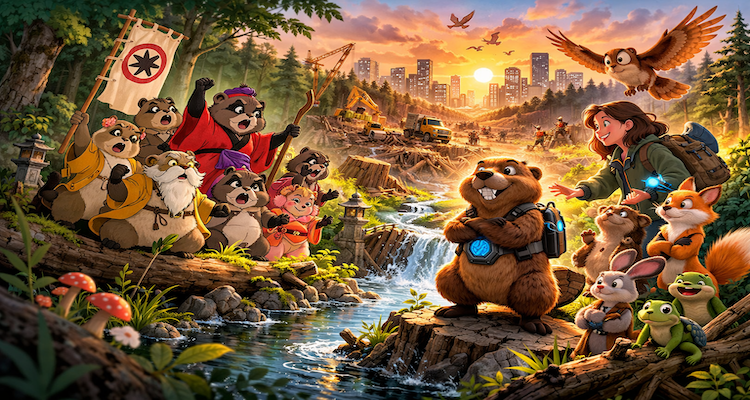
The breakthrough came when he shifted focus to beavers, animals known for their unique role in shaping ecosystems.
This pivot wasn’t just aesthetic. It reframed the entire narrative.
Why Beavers Became the Perfect Symbol
Beavers are often described as “ecosystem engineers,” capable of transforming landscapes and creating habitats for other species. That ecological role became central to Hoppers.
Chong saw in them a metaphor for regeneration and resilience, qualities that aligned with the film’s message about environmental healing.
In the film, protagonist Mabel, a 19-year-old college student, uses technology to project her consciousness into a beaver-like animatronic. Through this transformation, she becomes a bridge between human and animal worlds.
This dual perspective allows the story to explore coexistence rather than conflict, a theme that echoes Pom Poko but evolves it for a new audience.
The Influence of Pom Poko’s Storytelling
Chong has openly acknowledged that Pom Poko played a key role in shaping his thinking.
Takahata’s film portrays animals not just as victims of human expansion, but as active participants resisting it. The tanuki use their abilities to adapt, fight back, and even attempt to coexist with humans.
This layered storytelling balancing humor, tragedy, and folklore, left a lasting impression.
Chong recognized similarities between his own creative goals and Takahata’s vision: telling a story that examines how human actions ripple through the natural world.
Rather than copying the narrative, Hoppers reinterprets it, shifting from resistance to collaboration.
Two Perspectives, One Shared World
One of the most compelling elements of Pom Poko is its ability to present both human and animal viewpoints without simplifying either side.
Chong carried this idea into Hoppers, where Mabel represents both perspectives simultaneously.
As a human inhabiting an animal form, she embodies the tension, and potential harmony between the two worlds.
This narrative device allows the film to ask a deeper question: Can humans truly understand nature if they experience it from within?
The Broader Influence of Studio Ghibli
Pom Poko isn’t the only Ghibli film that shaped Chong’s work.
He has also cited My Neighbor Totoro, directed by Hayao Miyazaki, as a major influence. That film’s quiet reverence for nature and childhood wonder helped inform the tone of Hoppers.
Unlike many Western animated films that prioritize fast-paced storytelling, Ghibli’s works often linger on small, observational moments.
Chong appears to have embraced this sensibility, aiming to create a film that feels emotionally grounded while still engaging younger audiences.
Public and Industry Reaction
Since its release, Hoppers has drawn attention for its environmental themes and emotional depth.
Viewers and critics alike have noted its ability to balance entertainment with a meaningful message—a hallmark often associated with Studio Ghibli.
Animation enthusiasts have also welcomed Chong’s acknowledgment of Pom Poko, seeing it as a rare moment where a lesser-known film receives overdue recognition.
For longtime Ghibli fans, the connection feels both surprising and fitting.
Environmental Storytelling in Modern Animation
The success of Hoppers reflects a broader shift in animated storytelling.
Environmental narratives are no longer niche, they are becoming central to mainstream cinema. Films are increasingly exploring climate change, habitat loss, and human impact in ways that resonate across age groups.
Pom Poko was ahead of its time in this regard. Its influence on Hoppers highlights how earlier works continue to shape contemporary storytelling.
At a time when environmental concerns are more urgent than ever, these narratives carry added weight.
What This Means for Future Films
Chong’s approach signals a growing openness in Hollywood to draw inspiration from international storytelling traditions.
Rather than reinventing themes, filmmakers are reinterpreting them through new cultural and technological lenses.
This cross-cultural exchange enriches the medium, allowing stories to evolve while retaining their emotional core.
It also suggests that overlooked films like Pom Poko may continue to find new life through future projects.
Where to Watch Both Films
Hoppers is currently playing in theaters worldwide, attracting audiences with its blend of science fiction and environmental storytelling.
Meanwhile, Pom Poko remains accessible on major streaming platforms such as HBO Max and Netflix, depending on regional availability.
For viewers curious about the origins of Hoppers’ themes, revisiting Takahata’s work offers valuable context.
A Legacy That Quietly Endures
More than three decades after its release, Pom Poko continues to influence how stories about nature are told.
Its impact on Hoppers is a reminder that meaningful storytelling doesn’t always come from the most visible sources.
Sometimes, the most powerful ideas come from films that quietly challenge audiences to see the world differently.
As animation continues to evolve, that legacy is likely to endure, shaping stories that bridge cultures, generations, and perspectives.
This content is published for informational or entertainment purposes. Facts, opinions, or references may evolve over time, and readers are encouraged to verify details from reliable sources.