








Gold Smashes $5,000 as Trump Tariff Jitters Fuel Rush
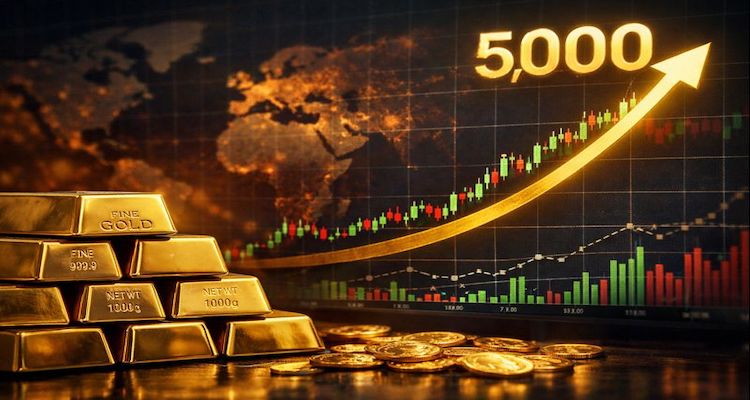
Gold has crossed a psychological and historic milestone surging above $5,000 an ounce as investors scramble for stability in an increasingly unpredictable global climate.
The rally is being powered by fresh geopolitical tensions, currency swings, and growing anxiety around U.S. policy signals that are rippling across markets.
Gold hits record territory above $5,000
Gold prices jumped to a fresh all-time high on Monday, extending what has already become one of the most dramatic safe-haven rallies in decades.
Spot gold rose 1.5% to $5,058.09 per ounce by 0544 GMT, after briefly touching a record peak of $5,092.71 earlier in the session.
U.S. gold futures for February delivery also climbed, gaining 1.6% to $5,056.60 per ounce, reflecting strong demand across both physical and futures markets.
A historic rally that keeps rewriting the record books
The move above $5,000 isn’t just another strong day for gold it’s the continuation of a surge that has been building for months.
Gold soared 64% in 2025, marking its strongest annual performance since 1979, driven by a powerful combination of investor fear, institutional buying, and shifting expectations around interest rates.
So far this year, prices are already up more than 17%, showing that the momentum hasn’t faded even after last year’s extraordinary run.
What’s driving gold higher right now?
Several forces have been stacking up behind gold’s relentless climb.
One key driver has been renewed safe-haven demand, as investors look for assets perceived to hold value during political shocks, diplomatic uncertainty, and market volatility.
At the same time, expectations of U.S. monetary policy easing have helped support gold, since lower interest rates typically make non-yielding assets like gold more attractive.
Another major pillar has been central bank buying, which has remained firm and consistent. China, in particular, has been a standout buyer logging its fourteenth straight month of gold purchases in December, reinforcing the perception that official-sector demand is providing a floor under prices.
Gold has also benefited from record inflows into exchange-traded funds (ETFs), signaling that institutional and retail investors alike have been returning to gold exposure in size.
Policy uncertainty in Washington adds fuel to the fire
The latest push higher appears tied to rising unease around U.S. political decision-making and its potential impact on global trade and diplomacy.
Kyle Rodda, a senior market analyst at Capital.com, said the recent catalyst has been a growing “crisis of confidence” in the U.S. administration and U.S. assets, triggered by erratic decision-making from the Trump administration last week.
Rodda added that investors are increasingly treating gold as the fallback option when traditional assumptions about stability begin to break down.
Trump’s tariff threats rattle markets
In recent days, President Donald Trump has made a series of trade-related statements that have kept investors on edge.
According to a Reuters report, Trump abruptly stepped back on Wednesday from threats to impose tariffs on European allies as leverage tied to Greenland.
Over the weekend, he also said he would impose a 100% tariff on Canada if it followed through on a trade deal with China.
In another escalation, Trump has threatened 200% tariffs on French wines and champagnes, in what appeared to be an effort to pressure French President Emmanuel Macron into joining his “Board of Peace” initiative.
Some observers have raised concerns that the initiative could weaken the United Nations’ role in conflict resolution, though Trump has said the board would work alongside the U.N.
The dollar slips as the yen rises
Currency markets also played a role in gold’s surge on Monday.
A strengthening Japanese yen pushed the U.S. dollar broadly lower early in the session, with traders staying alert for potential intervention in the yen and cutting dollar exposure ahead of this week’s Federal Reserve meeting.
That matters because gold is priced in dollars globally. When the dollar weakens, gold becomes cheaper for buyers using other currencies often increasing demand and pushing prices higher.
Where gold could go next
Market watchers are increasingly debating how far the rally can extend in 2026, especially if geopolitical tensions remain elevated and central banks continue accumulating bullion.
Analysts have suggested gold could climb toward $6,000 per ounce this year, supported by global uncertainty and sustained demand from both central banks and retail investors.
Philip Newman, director at Metals Focus, said he expects further gains and forecasts prices could peak near $5,500 later this year.
Newman also cautioned that pullbacks may occur as traders take profits, but said dips could be short-lived if buying interest remains strong.
Technical levels traders are watching
Beyond the macro story, technical traders are also tracking key resistance zones in the gold market.
Reuters technical analyst Wang Tao said spot gold may break resistance at $5,088 per ounce, and could then move toward the $5,168 to $5,188 range if the breakout holds.
Silver, platinum, and palladium surge alongside gold
Gold wasn’t the only metal in record territory. A broad rally across precious metals showed that investors are seeking shelter and momentum across the complex.
Spot silver jumped 3.8% to $106.8, after reaching a record $109.44 earlier in the session.
Platinum gained 1.3% to $2,802.30 per ounce, after touching a record high of $2,891.6 earlier Monday.
Palladium also climbed, rising 1.2% to $2,034.75 per ounce, after hitting its highest level in more than three years.
Silver breaks $100 as retail demand accelerates
Silver has been the standout in terms of speed and intensity, with a rally that has drawn attention far beyond traditional commodities desks.
Silver crossed above $100 for the first time on Friday, building on a staggering 147% rise last year.
According to Reuters, the move has been fueled by a mix of retail-investor flows and momentum-driven buying, amplified by ongoing tightness in physical silver markets.
What this rally means for investors and markets
The surge in gold and other precious metals is reshaping expectations across asset classes.
For investors, the rally signals that demand for “safety trades” is not fading it is expanding, and it’s doing so even as prices reach historically extreme levels.
For policymakers and central banks, the continued rise in gold reinforces the market’s sensitivity to political uncertainty, trade disruption, and shifting global alliances.
For consumers and industries that rely on precious metals, sustained price increases could eventually feed into higher costs, especially if volatility becomes the new normal.
A market built on uncertainty
Gold’s record run above $5,000 is more than a headline it reflects a market trying to price in risk that feels harder than usual to measure.
With investors watching the Federal Reserve, monitoring currency moves, and reacting to fast-changing geopolitical signals, gold’s role as a global “confidence barometer” appears stronger than ever.
If uncertainty persists, the appetite for hard assets may remain elevated even if the path higher includes sharp, temporary pullbacks along the way.
ALSO READ: Yen Surge Sparks Intervention Fears, Dollar Slides Globally
The information presented in this article is based on publicly available sources, reports, and factual material available at the time of publication. While efforts are made to ensure accuracy, details may change as new information emerges. The content is provided for general informational purposes only, and readers are advised to verify facts independently where necessary.