










EU Delays Vote on U.S. Trade Deal Amid Tariff Dispute
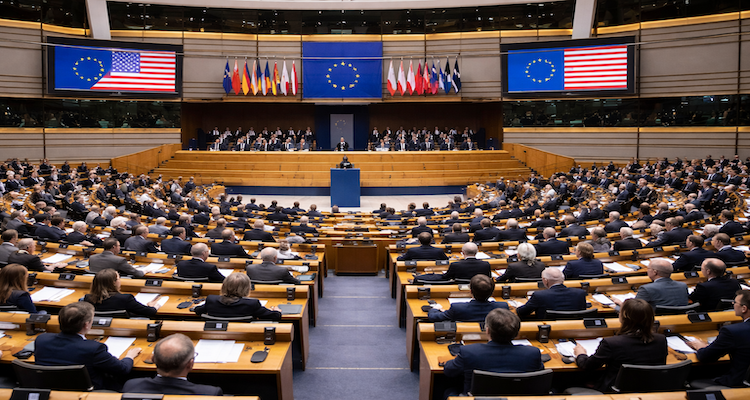
The European Parliament has postponed a crucial vote on the European Union’s trade agreement with the United States, injecting fresh uncertainty into transatlantic economic ties. The delay follows U.S. President Donald Trump’s decision to impose a sweeping 15% import tariff after the Supreme Court struck down his earlier global trade measures.
The move underscores rising tensions over the balance of concessions in a deal that many European lawmakers already viewed with skepticism.
Parliament Hits Pause on Trade Vote
The European Parliament was scheduled to hold a committee vote this week on legislative proposals central to the EU-U.S. trade agreement. Instead, lawmakers opted to delay the decision, according to two parliamentary sources familiar with the matter.
The vote in the trade committee had been expected to pave the way for formal approval of measures designed to ease tariffs on a broad range of American goods entering the European market. Those proposals form a cornerstone of the agreement struck in late July in Turnberry, Scotland.
However, President Trump’s recent move to implement a blanket 15% import duty on goods entering the United States has complicated the political landscape in Brussels.
The Turnberry Trade Framework
The trade deal under discussion emerged from negotiations held at the end of July in Turnberry. The agreement outlined a significant reduction in EU import duties on U.S. products and aimed to stabilize commercial ties following years of tariff disputes.
One specific element under review was the continuation of zero tariffs on U.S. lobster exports. That exemption was initially negotiated with President Trump in 2020 and has since been viewed as a symbolic measure of goodwill between Washington and Brussels.
Under EU law, the proposed tariff reductions require approval from both the European Parliament and EU member state governments before they can take effect.
Trump’s 15% Tariff Shifts the Debate
The postponement comes after President Trump introduced a broad 15% import tariff, replacing earlier global tariff measures that had been invalidated by the U.S. Supreme Court.
While the new tariff policy applies generally, it has significant implications for European exporters. Many members of the European Parliament argue that the agreement now appears uneven: the EU is expected to dismantle most of its import duties on American goods, while the U.S. maintains a flat 15% rate on incoming products.
The perceived imbalance has fueled debate within the Parliament’s trade committee and beyond.
Lawmakers Express Concerns Over Fairness
Several European lawmakers have voiced concerns that the trade deal disproportionately favors Washington.
According to parliamentary sources, critics argue that while the EU would commit to sweeping tariff reductions, American import duties would remain broadly intact. That asymmetry has raised questions about whether the agreement sufficiently protects European industries.
Despite these concerns, lawmakers had previously signaled a willingness to move forward, provided certain safeguards were included.
Among the proposed conditions were an 18-month “sunset clause” allowing for reassessment of the deal and mechanisms to respond if U.S. imports surge unexpectedly, potentially harming European producers.
A Second Suspension Signals Deeper Frictions
This marks the second time EU lawmakers have suspended work on the trade arrangement.
Earlier, parliamentary committees halted discussions in protest over President Trump’s controversial remarks about acquiring Greenland and warnings of additional tariffs on European allies who opposed the idea.
That earlier suspension highlighted how political tensions can spill into economic policymaking, complicating efforts to finalize trade agreements.
The current delay, while rooted in tariff policy, reflects similar strains.
Economic Stakes for Both Sides
The European Union and the United States maintain one of the world’s largest bilateral trade relationships. Hundreds of billions of euros in goods and services move between the two economies each year.
For European exporters, particularly in sectors such as automotive manufacturing, agriculture, and consumer goods, tariff stability is critical. A consistent 15% U.S. import duty could reduce competitiveness in key American markets.
On the other hand, American exporters have sought greater access to European markets, especially in agriculture and seafood. The continuation of zero duties on U.S. lobsters remains one of the more visible components of the broader agreement.
The delay therefore prolongs uncertainty for businesses on both sides of the Atlantic.
Political Calculations in Brussels
Trade policy in the European Union requires a delicate balance between economic strategy and political consensus.
Members of Parliament must weigh industry concerns, public opinion, and broader geopolitical considerations. The 15% U.S. tariff announcement has made that balancing act more difficult.
Some lawmakers appear cautious about endorsing a deal that could be perceived as conceding too much at a time when U.S. trade policy remains assertive.
Others argue that preserving predictable trade relations is preferable to renewed escalation.
Expert Perspective: Risk of Escalation
Trade analysts note that while the postponement does not amount to a rejection of the agreement, it sends a clear political signal.
A senior European trade policy expert, speaking on background due to the sensitivity of ongoing negotiations, said the delay reflects “a recalibration rather than a collapse.” According to the expert, Parliament is seeking leverage to ensure reciprocity before finalizing concessions.
Such pauses are not uncommon in major trade negotiations, particularly when domestic policy shifts alter the economic equation.
What Happens Next?
The trade committee’s vote will need to be rescheduled before the agreement can advance. Even after parliamentary approval, EU member states must also formally endorse the measures.
If the impasse persists, negotiations between Brussels and Washington could reopen to address concerns over tariff parity.
Alternatively, the deal could proceed with additional safeguards embedded into its implementation framework.
The next steps will depend heavily on political dialogue between the two sides and whether adjustments to U.S. tariff policy are forthcoming.
Broader Implications for Transatlantic Relations
The episode underscores the fragility of trade diplomacy in a period marked by shifting legal and political landscapes.
The U.S. Supreme Court’s decision to invalidate earlier global tariffs prompted a recalibration in Washington’s trade strategy. That recalibration, in turn, has forced European lawmakers to reconsider their own commitments.
For businesses and policymakers alike, the situation highlights the interconnected nature of domestic legal decisions and international economic agreements.
A Deal at a Crossroads
The European Parliament’s decision to postpone its vote does not signal the end of the EU-U.S. trade agreement—but it does reveal mounting unease over its balance and timing.
With billions in trade at stake, both sides face pressure to find common ground. Whether through renegotiation, safeguards, or diplomatic compromise, the coming weeks will determine whether the Turnberry framework moves forward or enters prolonged uncertainty.
For now, transatlantic trade policy remains in flux, an outcome that few businesses on either side of the Atlantic welcome.
Continue Exploring:
Avalanche Probe Intensifies After Sierra Tragedy
China’s Lunar New Year Travel Sets New Record
DOJ Details Redactions in Epstein Files
The information presented in this article is based on publicly available sources, reports, and factual material available at the time of publication. While efforts are made to ensure accuracy, details may change as new information emerges. The content is provided for general informational purposes only, and readers are advised to verify facts independently where necessary.