










Edison Sues LA County, Water Agencies Over Eaton Fire
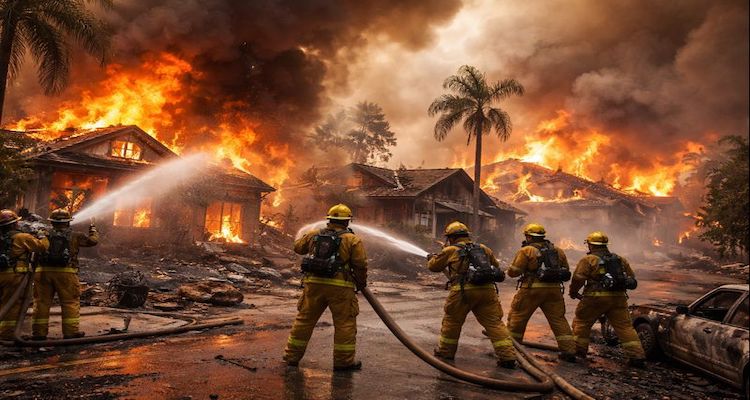
Southern California Edison is now pushing back in court over blame for the catastrophic Eaton fire, arguing the disaster wasn’t caused-or worsened by the utility alone.
The legal move raises fresh questions about public agency preparedness, evacuation timing, and infrastructure failures as wildfire lawsuits across California grow more complex and higher-stakes.
A fire that changed lives overnight
Southern California Edison (SCE), the major utility serving millions across the region, filed lawsuits Friday in Los Angeles Superior Court against Los Angeles County, several water agencies, and Southern California Gas Co.
According to a Reuters report, SCE claims these entities share responsibility for the deadly Eaton fire that tore through Southern California last year, destroying homes, businesses, and entire neighborhoods.
The Eaton fire began on January 7, 2025, and quickly became one of the most devastating disasters of the year.
Officials have said the blaze killed 19 people and destroyed more than 9,400 single-family homes and other structures, leaving thousands of families displaced and communities facing a long rebuilding process.
The core dispute: Who made the damage worse?
SCE’s lawsuits come as the company faces a wave of litigation from residents and business owners.
Nearly 1,000 separate lawsuits-about 998, according to the utility have been filed accusing SCE of responsibility for the destruction tied to the Eaton fire.
In earlier statements, SCE acknowledged that circumstantial evidence suggests one of its idled high-voltage transmission lines could have been involved in igniting the fire.
The company said this may have occurred during extreme wind conditions, with gusts reported above 100 mph (160 kph).
But in its newly filed court complaints, SCE argues that ignition is only part of the story and that several failures by local agencies may have intensified the human and property toll.
SCE’s allegations: Evacuation delays, water shortages, brush buildup
In its court filings, SCE points to what it describes as a series of breakdowns in emergency response and wildfire readiness.
The utility claims Los Angeles County and other government agencies failed to issue evacuation alerts in time, leaving people in danger as the fire spread rapidly.
SCE also alleges that insufficient water availability hindered firefighting operations when it mattered most.
In addition, the company blames overgrown brush on publicly owned land, arguing that vegetation management failures created more fuel for flames to move quickly and burn hotter.
The utility further claims that agencies did not allocate enough resources for fire suppression early on, when aggressive action can sometimes reduce the spread of fast-moving wildfires.
In the filings, SCE argues that if agencies had acted with proper care, much of the destruction and many of the injuries and deaths could have been prevented or reduced.
Why SoCalGas is now part of the case
SCE also filed a separate lawsuit against Southern California Gas Co. (SoCalGas), which distributes natural gas across the region.
SoCalGas is a subsidiary of Sempra, a major U.S. energy infrastructure company.
According to the complaint cited in the Reuters report, SCE claims risks and deficiencies in SoCalGas’ gas distribution system contributed to the fire spreading further than it otherwise might have.
SCE alleges SoCalGas was aware its system carried fire-related hazards but failed to include adequate mitigation steps.
The lawsuit claims this contributed to gas leaks, gas-fed fires, reignitions, and even explosions during the early stages of the Eaton fire.
These are serious allegations because gas infrastructure failures can complicate wildfire response, endanger first responders, and increase the difficulty of containing flames.
Responses: Silence from key defendants so far
As of Friday, Los Angeles County and Sempra did not respond to requests for comment, according to Reuters.
That leaves the public with major unanswered questions not only about what happened during the Eaton fire, but also about how agencies and utilities will defend their actions in court.
With multiple government bodies and private companies involved, the litigation is likely to be prolonged and closely watched across California.
The legal storm surrounding SCE keeps growing
SCE’s lawsuits do not reduce the legal exposure the company already faces.
The utility is currently dealing with 998 lawsuits filed by individuals and businesses, along with additional cases brought by insurers and government entities.
Separately, the U.S. Department of Justice sued SCE in September, seeking damages tied to harm caused to National Forest System lands, Reuters reported.
That federal case adds another layer of pressure, because it brings national scrutiny and the potential for significant financial penalties.
Public reaction: Communities still searching for accountability
For residents who lost homes-or loved ones-the new lawsuits may feel like another painful chapter in a tragedy that hasn’t ended.
Wildfire survivors often want clear answers: what started the fire, what could have stopped it, and who is responsible for preventing the next one.
SCE’s legal argument signals that the company is preparing for a long courtroom battle where responsibility may be divided across multiple agencies and infrastructure operators.
That approach could reshape how future wildfire lawsuits are fought especially when disaster response failures are alleged alongside possible ignition sources.
Compensation update: Claims, offers, and payouts
SCE says thousands of families have already turned to its compensation process.
Nearly 2,000 families have submitted claims through the company’s Wildfire Recovery Compensation Program, according to Reuters.
The utility says it has made 95 offers totaling $42.8 million, with more than half of those offers already accepted.
In a statement cited by Reuters, SCE spokesperson David Eisenhauer said the company remains committed to helping impacted communities recover.
Impact analysis: What this could mean for wildfire accountability
The Eaton fire lawsuits highlight how wildfire disasters are no longer viewed through a single-cause lens.
Even when investigators focus on possible ignition sources such as electrical equipment court fights increasingly examine what happened next: evacuation timing, firefighting readiness, fuel management, and infrastructure resilience.
SCE’s claims against LA County, water agencies, and SoCalGas could influence how future wildfire liability is distributed, especially if courts decide that response failures played a measurable role in the scale of destruction.
At the same time, the lawsuits underscore the fragile interdependence of critical systems during disasters.
Electric utilities, gas distribution networks, and water delivery systems all operate as lifelines yet each can become a risk multiplier when extreme weather, high winds, and wildfire conditions collide.
What happens next
The cases are expected to move through Los Angeles Superior Court, where the volume of litigation alone suggests years of legal proceedings ahead.
As evidence is reviewed, the key question will remain whether the Eaton fire’s devastation was primarily the result of a single ignition source, or a chain of failures across multiple systems and agencies.
For Southern California, where climate-driven wildfire risk is expected to remain severe, the outcome could set precedents affecting safety planning, emergency alerts, vegetation management, and infrastructure investment.
A fight over responsibility, and a warning for the future
The Eaton fire left behind more than burned structures, it exposed how quickly modern communities can be overwhelmed when wind, fuel, and infrastructure vulnerabilities align.
Now, SCE’s lawsuits are shifting the spotlight toward government preparedness and utility coordination, setting up a broader reckoning over what went wrong and what must change.
For the families rebuilding their lives, the court battle may not bring back what was lost, but it could determine who pays, who reforms, and how California prepares for the next major fire season.
(With inputs from Reuters.)
ALSO READ: Britain’s EV Shift Sparks a Surprise Green Car Boom
Disclaimer:
The information presented in this article is based on publicly available sources, reports, and factual material available at the time of publication. While efforts are made to ensure accuracy, details may change as new information emerges. The content is provided for general informational purposes only, and readers are advised to verify facts independently where necessary.