










Choking Cities: The Global Toll of Toxic Air
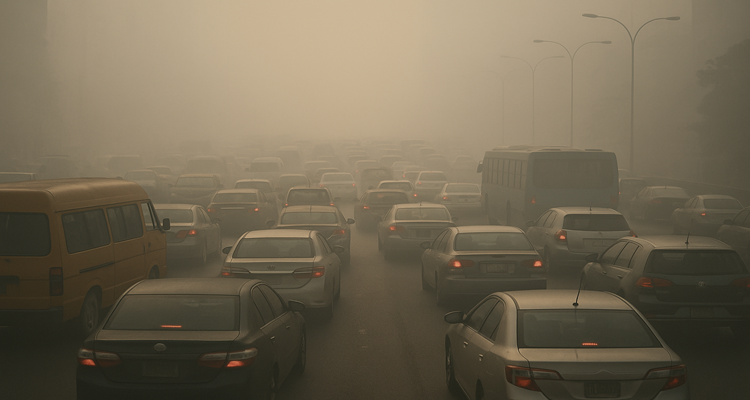
Air pollution is driving millions of premature deaths, crippling economies, and deepening global inequality. Here’s why the fight for clean air cannot wait.
A Morning That Steals Breath Before the Day Begins
At sunrise in Lagos, the haze hangs thick before the city even wakes. Vendors tie cloths across their mouths as danfo buses belch exhaust into the morning air. Comfort, who relies on selling roasted corn to survive, forces back another cough an illness she cannot afford to treat. Her struggle mirrors that of millions around the world, where simply breathing has become a daily health risk.
A Crisis Years in the Making
Air pollution is now one of humanity’s deadliest threats, surpassing malaria, tuberculosis, and HIV/AIDS combined. World Bank data shows roughly 6 million people die prematurely every year from toxic air. The State of Global Air 2024 report paints an even starker picture: 8.1 million deaths in 2021, making pollution the second-leading risk factor for death worldwide.
The most heartbreaking statistic of all:
More than 700,000 children under five lost their lives that year to polluted air, amounting to 15% of all global under-five deaths.
A World Breathing Unsafe Air
Nearly 99% of humanity now inhales air that exceeds the World Health Organization’s recommended safety thresholds. The burden is heaviest in low- and middle-income countries, where rapid urbanization, lax regulation, and reliance on fossil fuels collide.
Cities like Delhi, Dhaka, and Lagos routinely record PM2.5 concentrations 10 to 15 times higher than what is considered safe. These microscopic particles slip into the bloodstream and damage nearly every organ.
According to the UN’s 2025 Sustainable Development Goals Report, global progress on reducing pollution-related deaths is far off track. Nations experiencing fast growth yet battling weak infrastructure are falling furthest behind.
The Hidden Economic Price Tag
Air pollution is not just a public health emergency; it is also a massive economic threat.
Exposure to PM2.5 drains US$4.5 trillion to US$6.1 trillion from the global economy each year, equivalent to 5–6% of global GDP. Labor productivity drops. Workers fall sick more often. Medical bills rise. Whole families slip deeper into poverty.
South Asia alone forfeits as much as 8.9% of its GDP to illnesses linked to toxic air.
Yet despite the colossal financial burden, international support remains perilously small. Between 2015 and 2024, only 1% of global development aid went toward clean air initiatives. Regions suffering the worst impacts, South Asia and sub-Saharan Africa, received less than 5% of that limited funding.
Lives Caught in the Crossfire
Behind every data point is a human story.
In Accra, Ghana, tricycle driver Kwesi spends nearly ten hours a day navigating exhaust-choked streets. The fumes cling to him long after his shift ends. In Nairobi, Grace, a single mother, watches most of her income disappear into hospital bills for her five-year-old son, whose chronic bronchitis stems from charcoal smoke and heavy traffic.
Health workers see the crisis unfold in real time. In Dhaka, Bangladesh, where textile factories and motorbikes create a perpetual haze, doctor Ayesha Akter told WHO researchers that the air infiltrates everything: “The pollution outside is the same pollution filling our wards.”
The economic cost reverberates locally, too. Air pollution erodes 1.3% of India’s GDP, 1.2% of Ethiopia’s, and 0.95% of Ghana’s. Each missed workday or asthma attack further widens the gap between the rich and the poor.
Policy Shifts That Show Progress Is Possible
Despite the grim numbers, several countries are demonstrating that bold policy can reverse air quality decline:
Rwanda: Cleaner Skies Through Stricter Vehicle Standards
By banning used and diesel vehicles in 2019, Rwanda cut pollution in Kigali by over 25% in five years, according to UNEP.
India: Aiming for Nationwide Pollution Reduction
India’s National Clean Air Programme (NCAP) seeks a 40% cut in particulate matter by 2026. While progress varies, cities like Indore and Ahmedabad have recorded measurable improvements.
Chile: Betting on Electric Transport
Chile’s investment in electric buses has lowered emissions equivalent to removing nearly 3,000 wood-burning stoves.
These examples illustrate what research consistently shows: clean air is not an expense it’s an economic multiplier. The World Bank estimates that halving PM2.5 exposure by 2040 would require about US$3.2 trillion, but could generate up to US$2.4 trillion in economic returns.
Why Clean Air Is a Development Imperative
Air pollution touches nearly every major Sustainable Development Goal:
-
SDG 3: Good Health, millions of preventable deaths
-
SDG 8: Decent Work reduced productivity and income loss
-
SDG 11: Sustainable Cities worsening livability in urban centers
-
SDG 13: Climate Action shared roots between air pollution and greenhouse gas emissions
Without stronger policy action, the World Bank’s 2025 modeling warns that annual deaths from air pollution could rise from 5.7 million in 2020 to 6.2 million by 2040. The number of people exposed to hazardous air above 25 µg/m³ could increase by 21%, with the sharpest spikes in sub-Saharan Africa, Central Asia, and the Middle East.
A Global Call to Clear the Air
The message is unmistakable: air pollution is not a peripheral environmental issue, it is a direct barrier to human progress. It steals young lives, weakens economies, and traps nations in cycles of poverty.
Until funding and policies match the urgency of the crisis, the world’s most vulnerable communities will continue to bear the heaviest burden. Clean air is not merely an environmental goal it is the foundation of healthier societies, stronger economies, and sustainable development.
The Future Depends on the Air We Breathe
The fight for clean air is a fight for equity, resilience, and economic stability. Suppose global leaders treat the pollution crisis with the seriousness it demands. In that case, millions of lives can be saved, and the world’s poorest regions can begin to break free from the grip of preventable illness and lost opportunity.
The path forward is clear. What remains is the collective will to act.
ALSO READ: The Atmospheric Whispers No Human Can Hear