










Cabinet Hikes Copra MSP for 2026 Season, Boosting Farmer Confidence and Coconut Economy
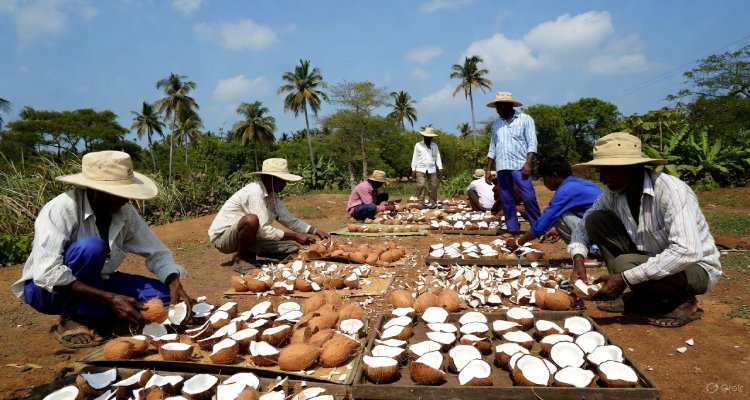
India’s Cabinet has raised the MSP for copra for the 2026 season, aiming to boost farmer income, stabilize prices, and support coconut-growing states.
Introduction: A Timely Price Signal for Coconut Farmers
At a time when global food prices remain volatile and climate uncertainty continues to test agricultural resilience, India’s Union Cabinet has delivered a decisive policy signal to coconut farmers. The Cabinet Committee on Economic Affairs (CCEA), chaired by Prime Minister Narendra Modi, has approved a significant hike in the Minimum Support Price (MSP) for copra for the 2026 marketing season.
The move reinforces the government’s long-standing commitment to ensuring remunerative prices for farmers, particularly small and marginal cultivators who form the backbone of India’s agricultural economy.
Context & Background: Why Copra MSP Matters
Copra, the dried kernel of coconut, is a critical agricultural commodity with wide applications across edible oils, confectionery, cosmetics, pharmaceuticals, and emerging wellness products. India is one of the world’s largest producers of coconuts, with Karnataka, Tamil Nadu, and Kerala accounting for a substantial share of national output.
The copra marketing season typically runs from January to April, a period when market arrivals peak and prices are most vulnerable to fluctuations. Without a robust price support mechanism, farmers often face distress sales during periods of excess supply.
To address this structural challenge, the MSP framework acts as a safety net, ensuring farmers receive a guaranteed minimum price irrespective of market volatility.
Main Developments: What the Cabinet Approved
Under the newly approved decision for the 2026 season, the government has revised MSP rates upward for both major copra varieties:
- Milling copra: MSP increased by ₹445, taking the price to ₹12,027 per quintal
- Ball copra: MSP raised by ₹400, fixing the price at ₹12,500 per quintal
The Cabinet reaffirmed that these prices comply with the government’s policy of fixing MSPs at at least 1.5 times the all-India weighted average cost of production, a benchmark first announced in the Union Budget 2018–19.
Procurement operations will continue to be carried out by NAFED and the National Cooperative Consumers’ Federation (NCCF), which will function as Central Nodal Agencies under the Price Support Scheme.
Understanding MSP: A Pillar of Agricultural Stability
The Minimum Support Price is more than a procurement mechanism—it is a foundational instrument of India’s agricultural policy. It provides farmers with a pre-announced price guarantee before sowing, encouraging investment in inputs, technology adoption, and productivity enhancement.
With nearly 86 percent of Indian farmers classified as small and marginal, MSP helps prevent income shocks while also stabilizing consumer prices by discouraging extreme supply cycles.
Genesis of MSP: Lessons from India’s Agrarian Past
India’s MSP system emerged from the country’s post-Independence struggles with food scarcity. During the mid-1960s, repeated shortages exposed the fragility of agricultural production. In response, the government undertook wide-ranging reforms, including land restructuring, institutional strengthening, agricultural research expansion, and the introduction of price support policies.
The Green Revolution, supported by assured prices, transformed India from a food-deficit nation into a largely self-sufficient agricultural economy. MSP has remained central to that transformation.
How MSP Is Fixed: The Role of CACP
The process of fixing MSPs is grounded in data and consultation. The Commission for Agricultural Costs and Prices (CACP), established in 1965, serves as the government’s advisory body on farm pricing.
Each year, the Commission evaluates production costs, market trends, demand-supply dynamics, and regional disparities. It engages extensively with state governments, farmers’ groups, procurement agencies, traders, and central ministries before submitting its price policy reports.
Final approval rests with the Cabinet Committee on Economic Affairs, ensuring policy decisions reflect both economic analysis and national priorities.
Expert Insight & Farmer Sentiment
Agricultural economists view the copra MSP hike as a confidence-building measure for oilseed and plantation crop growers. By aligning prices with rising input costs and global demand trends, the government signals predictability—an essential factor for long-term farm planning.
Farmer organizations in coconut-producing states have welcomed the decision, noting that higher MSPs could encourage reinvestment in plantations, improved irrigation, and better post-harvest practices.
Impact & Implications: What Comes Next
The revised MSP is expected to have multiple ripple effects:
- Higher farmer income stability during peak arrival months
- Increased copra production, supporting India’s growing domestic and export demand for coconut products
- Market price stabilization, reducing distress sales
- Stronger rural economy in coconut-dependent regions
For consumers, the MSP framework helps prevent extreme price spikes caused by supply shortages in subsequent seasons.
Conclusion: Reinforcing Trust in Agricultural Policy
The Cabinet’s decision to hike the copra MSP for the 2026 season underscores the continued relevance of price support in India’s evolving agricultural landscape. By balancing farmer welfare with market stability, the move strengthens trust in policy institutions while supporting a crop that plays a vital role in food security, livelihoods, and export growth.
As India navigates climate challenges and shifting global demand, such calibrated interventions will remain crucial to sustaining its agricultural economy.
Disclaimer :This article is based solely on officially available policy inputs and public information. It does not constitute financial or investment advice.