









‘Bal Vivah Mukt Bharat’: India Launches a Nationwide Mission to End Child Marriage
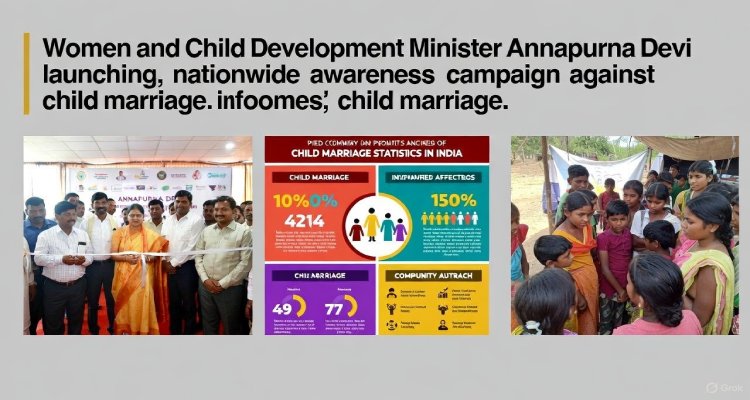
India launches a 100-day national campaign under ‘Bal Vivah Mukt Bharat’ to eliminate child marriage through awareness, legal reforms, and stronger enforcement.
Introduction: A New Push to End an Old Injustice
On December 4, India took a decisive step against one of its most persistent social challenges—child marriage. Union Minister for Women and Child Development Annapurna Devi launched a 100-day Intensive Awareness Campaign under the national initiative ‘Bal Vivah Mukt Bharat’ (Child Marriage Free India). The effort marks the completion of one year of the flagship program and signals a renewed, urgent push to protect millions of children from early marriage and its lifelong consequences.
Context & Background: Confronting a Deep-Rooted Social Harm
Child marriage, despite decades of reform efforts, remains one of India’s most entrenched social issues. Globally, one in every five girls is married before turning 18. In India, although rates have steadily declined over the past two decades—from 47% in 2006 to 23.3% in 2021—progress remains uneven, especially across rural and economically marginalised communities.
The Prohibition of Child Marriage Act (PCMA), 2006 governs India’s legal framework on the issue, defining child marriage as unions where girls are below 18 and boys below 21. Despite legal protections, social norms, patriarchy, poverty, and lack of education continue to fuel underage marriages.
The government’s intensified campaign aims to bridge this gap between law and lived reality.
Main Developments: A National Campaign Built for Impact
1. A Multi-Ministry, Grassroots-Driven Drive
The new 100-day awareness effort will roll out in coordination with key ministries:
- Health & Family Welfare
- Panchayati Raj
- Rural Development
- Education
This structure ensures deep penetration into rural communities—where most child marriages occur—and aligns the campaign with departments that influence health, schooling, livelihood, and local governance.
2. Launch of the ‘Bal Vivah Mukt Bharat’ Digital Portal
A major milestone of the campaign is the launch of a dedicated portal that:
- Provides public access to Child Marriage Prohibition Officers (CMPOs)
- Hosts awareness materials and outreach records
- Enables easy, confidential reporting of child marriage cases
- Strengthens transparency and accountability
This centralized digital infrastructure marks a critical shift toward data-driven governance and real-time interventions.
3. Stronger Legal and Administrative Objectives
The campaign outlines ambitious goals:
- Advocate for 18 as the universal minimum marriage age, without exceptions
- Strengthen the supervision of CMPOs
- Make public information on CMPOs widely accessible
- Build simple, user-friendly reporting systems
- Expand community-level awareness programs
The mission is clear: prevention, enforcement, and empowerment must work hand in hand.
What Drives Child Marriage? A Look at Social and Economic Realities
Despite laws and rising awareness, several pressures continue to steer families toward child marriage:
- Patriarchal norms: Girls are often viewed through a lens of purity, honour, and domestic responsibility.
- Poverty: Early marriage is seen as a way to reduce financial burden.
- Lack of education: When schooling stops, marriage becomes the default path.
- Structural inequalities: Gender, caste, class, and rural-urban divides exacerbate risks.
- Dowry pressures: Families often believe younger brides command smaller dowries.
Child marriage is recognised by the UN Convention on the Rights of the Child as a violation of fundamental human rights—and ending it is a key indicator under SDG 5 (Gender Equality).
Yet, experts warn that to meet global targets, progress must accelerate 12 times faster than current rates.
Child Marriage in India: Numbers and Trends
Data from the National Crime Records Bureau (NCRB) reflects both awareness and enforcement trends. Cases registered under PCMA were:
- 785 cases in 2020
- 1,050 cases in 2021
- 1,002 cases in 2022
While reporting has increased, these numbers represent only a fraction of actual incidents. Surveys indicate that India’s child marriage rates have halved since 2006—a commendable decline but still far from elimination.
No global region is on track to fully achieve the SDG target of eradicating child marriage.
Expert Insight and Public Response
Experts stress that legal action alone cannot dismantle a system rooted in centuries of social norms.
“Ending child marriage requires cultural transformation more than punitive measures,” says a Delhi-based child rights advocate. “Education, economic stability, and community trust are the pillars that sustain long-term change.”
Grassroots organizations have welcomed the government’s renewed push, especially the portal, which is expected to make reporting more accessible. However, activists caution that CMPOs must be adequately trained, staffed, and monitored to ensure genuine impact.
Challenges: The Roadblocks That Persist
Despite improvements, several persistent challenges threaten progress:
1. Implementation Gaps Under the PCMA
While the law provides penalties—including up to two years of imprisonment and a fine of ₹1 lakh—enforcement remains inconsistent. Many cases go unreported due to fear, stigma, or community pressure.
2. Lack of Targeted, Long-Term Interventions
Current schemes emphasize education and training but lack systems to track long-term outcomes in vulnerable regions.
3. Financial Aid That Misses the Most Vulnerable
Benefits often fail to reach the lowest-income and marginalized communities where child marriage risk is highest.
4. Loopholes Around Betrothal
The PCMA prohibits marriage but not child betrothal, which often leads to later forced unions—an area rights groups urge lawmakers to address.
Impact & Implications: What Comes Next?
The new campaign could reshape India’s fight against child marriage in three major ways:
- Digital transparency will improve monitoring and accountability.
- Multi-ministry coordination will allow more holistic interventions.
- Intensive awareness drives may shift cultural attitudes at the grassroots level.
If successful, India could significantly accelerate its progress toward SDG 5 and set a global example for scaling community-led solutions.
However, experts emphasize that meaningful change requires continuous evaluation, stronger rehabilitation mechanisms for minors, and greater investment in the training of CMPOs, teachers, health workers, and local officers.
Conclusion: A National Commitment With Generational Impact
The ‘Bal Vivah Mukt Bharat’ campaign marks a critical moment in India’s decades-long battle against child marriage. It combines digital tools, community outreach, legal advocacy, and systemic coordination—an approach that acknowledges both the complexity of the problem and the urgency to address it.
As India intensifies its mission over the next 100 days and beyond, the real measure of success will lie not only in declining statistics but in ensuring every child—especially every girl—has the freedom to learn, grow, and choose her own future.
Disclaimer:This article is for informational and educational purposes only. It does not provide legal advice and should not be used as a substitute for professional guidance.