








Asian Currencies Climb as Dollar Stays Weak
Asian currencies strengthened on Monday as fresh uncertainty around U.S. trade policy weighed on the dollar, giving emerging markets room to rally. Equity markets across the region also advanced, with South Korea and Taiwan setting the pace amid continued enthusiasm for artificial intelligence-linked sectors.
The moves signal a shift in investor sentiment: instead of reacting defensively to tariff threats, markets are recalibrating around competitiveness, supply chain resilience, and the global AI boom.
Dollar Weakness Lifts Emerging Asia
The MSCI Emerging Market Currency Index edged 0.24% higher, hovering near the record level it touched earlier this month. A softer U.S. dollar provided broad support, helping several Asian currencies post notable gains.
The Malaysian ringgit rose 0.4%, while the Philippine peso jumped 0.9% to its strongest level since late September. The Singapore dollar added 0.2%, and the South Korean won, Thai baht, and Taiwanese dollar each gained more than 0.3%.
The dollar index slipped after U.S. President Donald Trump announced a 15% blanket import levy, a move that followed a Supreme Court ruling against his earlier sweeping tariffs. The new tariff framework introduced fresh uncertainty about Washington’s trade direction, adding pressure to the greenback.
Currency markets typically react quickly to trade policy shifts, especially when they affect global supply chains and export-dependent economies. Monday’s moves reflected that sensitivity.
Tariff Reset Brings Mixed Relief
A 15% global tariff rate could offer limited relief to several Asian economies compared to previous scenarios, according to analysts at Barclays. India and ASEAN members such as Malaysia, Thailand, Indonesia, the Philippines, and Vietnam may benefit from a more predictable baseline tariff environment.
However, Singapore faces a different equation. With its current tariff rate standing at 10%, a shift to 15% would represent an increase rather than a reduction, potentially narrowing its relative advantage.
The broader takeaway for investors is that the worst-case tariff escalation fears have moderated. Instead of bracing for disruptive trade wars similar to 2018, markets are beginning to focus on structural positioning.
AI-Focused Markets Lead Equity Gains
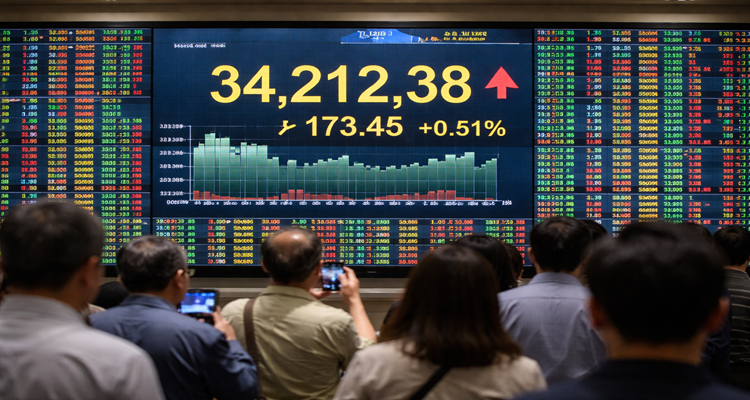
Regional equity markets mirrored the currency strength. Taiwan’s benchmark index surged to a record intraday high of 34,212.38 before ending the session 0.5% higher. Shares of Taiwan Semiconductor Manufacturing Company (TSMC), a cornerstone of the global chip supply chain, climbed 1% to a new peak.
South Korea’s KOSPI index also advanced 0.7%. The benchmark had earlier jumped 2.1% during trading, touching an all-time high before paring gains. Both Taiwan and South Korea have emerged as major beneficiaries of the AI-driven demand cycle, given their dominant roles in semiconductor production and advanced manufacturing.
Investors are now awaiting earnings from Nvidia later this week. The U.S.-based chip designer carries significant market influence, accounting for nearly 8% of the S&P 500’s weighting. Its results are widely seen as a barometer for the sustainability of the AI rally.
A Shift in Market Narrative
Market strategists say the story in emerging Asia is evolving.
Billy Leung, investment strategist at Global X ETFs Australia, noted that investor focus has moved away from tariff anxiety toward competitive positioning. He said supply chains are now more diversified than they were during the 2018 trade tensions, reducing vulnerability to single-country disruptions.
Leung also pointed out that economies tied to AI hardware, capital goods, and advanced manufacturing appear better positioned than those reliant solely on traditional exports.
That divergence is becoming more visible in capital flows.
Glenn Yin, director of research at AC Capital Market, observed that AI-linked North Asian markets continue to attract investor inflows. Meanwhile, trade-sensitive and high-beta markets remain exposed to sudden policy shifts.
His assessment underscores a growing dispersion within emerging Asia, where not all markets are moving in tandem despite broader currency support.
Indonesia, Thailand, Philippines Join Rally
Elsewhere in Southeast Asia, Indonesian equities climbed 1.4%. The rally followed an announcement from the Indonesia Stock Exchange late Friday outlining capital market reforms. The measures came after MSCI warned in January that Indonesia risked being downgraded to frontier market status as early as May.
The reform package appears to have reassured investors, at least in the short term.
Thai equities rose as much as 1.5%, reaching their highest level since mid-October 2024. Philippine stocks advanced 1%, while Singapore and Malaysia posted more modest gains of 0.2% and 0.3%, respectively.
The synchronized rise across equities suggests a broader improvement in regional risk appetite, supported by currency stability and easing external pressures.
Central Banks in Focus
Monetary policy remains another key driver for markets this week.
The Bank of Thailand is widely expected to keep interest rates unchanged, with analysts anticipating a final rate cut in the second quarter. Stable rates could help anchor investor confidence while allowing policymakers to monitor global developments.
In Japan, attention has turned to the possibility of further tightening. A former Bank of Japan policymaker indicated that a rate hike in March could be considered if the yen resumes its slide. That potential shift adds another layer of complexity to Asia’s currency landscape.
Why It Matters for Global Investors
The combination of a softer dollar, recalibrated U.S. trade policy, and AI-driven growth momentum is reshaping the outlook for emerging Asia.
Currency strength can help reduce imported inflation pressures and improve investor confidence in local assets. At the same time, record highs in Taiwan and South Korea highlight how technology supply chains are becoming central to regional performance.
However, dispersion remains a defining feature. Markets deeply integrated into AI hardware production appear more resilient, while those dependent on broad-based exports remain sensitive to trade policy swings.
Investors are also closely watching U.S. corporate earnings, particularly in the semiconductor sector. Strong guidance from major AI players could reinforce capital flows into North Asian equities. Conversely, disappointment could trigger volatility across emerging markets.
A Region at a Crossroads
Asia’s emerging markets are navigating a delicate balance between global trade uncertainty and technological opportunity.
For now, a weaker dollar has provided breathing room. Tariff fears have eased, though not disappeared. And AI-related industries continue to attract investment at a pace that is lifting select markets to record highs.
The coming weeks, shaped by central bank decisions, U.S. corporate earnings, and any further shifts in trade policy, will test whether this rally has durable foundations.
What is clear is that the region is no longer moving as a single bloc. Competitiveness, sector exposure, and policy stability are increasingly defining winners and laggards in emerging Asia’s evolving story.
(With inputs from Reuters.)
Continue Exploring:
Dollar Rallies on Fed Signals, Iran Tensions
Markets Steady After Rally; AI Concerns Linger
Asian Markets Climb as Tech Rally Offsets Tensions
The information presented in this article is based on publicly available sources, reports, and factual material available at the time of publication. While efforts are made to ensure accuracy, details may change as new information emerges. The content is provided for general informational purposes only, and readers are advised to verify facts independently where necessary.