










Aramco’s Jafurah Condensate Heads to Global Markets
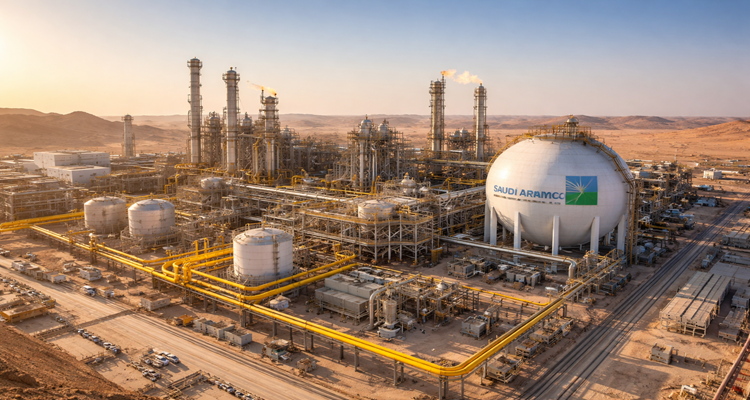
Aramco’s Gas Bet Moves From Blueprint to Barrels
Saudi Aramco has begun marketing condensate from its massive Jafurah shale gas development, marking a pivotal step in the kingdom’s strategy to expand beyond traditional crude oil exports.
According to a Reuters report citing trade sources, the state energy giant has sold multiple cargoes of ultra-light crude from the $100 billion project to major U.S. oil companies and an Indian refiner, with the first export expected later this month.
The sales underscore Saudi Arabia’s growing ambitions in the global natural gas and light liquids markets at a time when energy producers are diversifying portfolios to adapt to shifting demand patterns.
First Buyers: U.S. Majors and Indian Refiner
Trade sources told Reuters that Chevron has secured two cargoes of Jafurah condensate for loading later this month and in March. Exxon Mobil and India’s largest refiner, Indian Oil Corp (IOC), have also purchased shipments scheduled for lifting next month.
The condensate cargoes were reportedly sold at premiums ranging from $2 to $3 per barrel above Dubai benchmark prices on a free-on-board (FOB) basis.
While Aramco and the buyers did not immediately issue official comments, Chevron declined to provide details. Exxon, IOC, and Thailand’s Star Petroleum Refining Public Company Limited (SPRC) did not respond to media queries at the time of reporting. GS Caltex also had no immediate comment.
South Korea and Thailand in the Supply Chain
Chevron’s first cargo is expected to be delivered to GS Caltex, its joint-venture refining partner in South Korea. A second shipment may head to Thailand for processing at Star Petroleum Refining, according to two of the trade sources cited by Reuters.
These early transactions suggest that Asian refiners will be among the primary destinations for Jafurah condensate, reflecting the region’s sustained appetite for petrochemical feedstocks and light refined products.
What Makes Jafurah Significant?
Jafurah is widely regarded as the largest shale gas development outside the United States. The project is estimated to hold approximately 229 trillion standard cubic feet of raw gas and about 75 billion barrels of condensate.
For Saudi Aramco, Jafurah is more than just another upstream investment. It represents a strategic pivot toward natural gas and associated liquids, sectors that are increasingly critical in global energy markets as countries pursue cleaner-burning fuels relative to heavier hydrocarbons.
The company has projected that the field will achieve sustainable production of 2 billion cubic feet per day by 2030. Once fully ramped up, Jafurah is expected to significantly expand Saudi Arabia’s gas output while also adding new streams of high-value condensate to global markets.
Export Plans From Yanbu
Reuters previously reported that Aramco could export between four and six condensate cargoes per month from Yanbu, the kingdom’s eastern port. Each cargo is expected to be approximately 500,000 barrels.
If realized, this export volume would establish Jafurah as a meaningful new supply source in the ultra-light oil segment, potentially influencing pricing dynamics in Asia and beyond.
Condensate production at scale also provides Aramco with additional flexibility. The company can choose to blend the product with crude oil streams or market it directly to refiners and petrochemical processors.
Understanding Condensate: A High-Value Liquid
Condensate is a light hydrocarbon liquid that separates from natural gas during production. Unlike heavier crude oils, it has a higher API gravity and lower sulfur content, making it easier and less costly to process.
According to a preliminary crude assay reviewed by Reuters, Jafurah condensate has an API gravity of 49.7 degrees and contains roughly 0.17% sulfur. These characteristics classify it as ultra-light and relatively sweet, qualities that are typically attractive to refiners.
The assay also indicates that about 40% of the output yields petrochemical-grade naphtha, predominantly heavier-grade naphtha. The remainder is largely composed of gasoil and kerosene fractions.
This product slate makes Jafurah condensate especially valuable for petrochemical producers seeking feedstock for plastics and other materials, as well as refiners producing transportation fuels.
Strategic Shift Toward Gas and Petrochemicals
Aramco’s move into shale gas and condensate exports reflects broader shifts in the global energy landscape.
While oil remains the backbone of Saudi Arabia’s economy, natural gas is increasingly viewed as a bridge fuel in the global energy transition. Expanding gas output allows the kingdom to reduce domestic crude burning for power generation, freeing up more oil for export.
At the same time, producing condensate supports the growth of petrochemical industries, a sector that continues to see strong long-term demand due to plastics, packaging, and industrial materials.
By positioning Jafurah as both a gas and liquids play, Aramco is building a more diversified hydrocarbon portfolio that can weather fluctuations in crude markets.
Pricing Signals and Market Impact
The reported premium of $2 to $3 per barrel above Dubai benchmarks suggests solid initial demand for the new grade.
Pricing relative to Dubai crude is particularly relevant for Asian buyers, where Dubai serves as a key benchmark for Middle Eastern oil sales.
If Jafurah condensate consistently commands premiums, it could signal robust appetite among refiners for lighter feedstocks, especially as Asian petrochemical capacity continues to expand.
However, market dynamics will depend on production ramp-up, competing condensate supplies from the United States and Qatar, and broader global demand trends.
Industry Perspective
Energy analysts have long viewed Jafurah as one of the most consequential shale projects outside North America. Its scale places it in rare company globally, and its success could demonstrate the viability of shale development beyond U.S. basins.
With natural gas markets becoming increasingly interconnected through liquefied natural gas (LNG) trade and petrochemical value chains, projects like Jafurah may reshape regional energy balances.
According to reporting by Reuters, Aramco’s ability to begin exporting condensate signals that the project is transitioning from the development phase to commercial output, a key milestone for a multi-decade investment.
What Comes Next?
If exports proceed as planned later this month, Jafurah condensate will formally enter the global supply system.
Over the next several years, as production scales toward the targeted 2 billion cubic feet per day, Saudi Arabia could emerge as a more prominent player in both gas and light liquids markets.
For international buyers, particularly in Asia, Jafurah offers a new source of ultra-light feedstock at a time when refiners are optimizing operations for efficiency and product flexibility.
A Broader Energy Evolution
Saudi Aramco’s first condensate sales from Jafurah represent more than a routine trade transaction. They mark the operational debut of a project central to the kingdom’s long-term energy strategy.
As global demand patterns evolve and energy producers diversify revenue streams, Jafurah stands as a symbol of Saudi Arabia’s effort to adapt, leveraging its vast resources to compete not only in crude oil but increasingly in gas and high-value light hydrocarbons.
(With inputs from Reuters.)
Continue Exploring:
Oil Prices Slide as Iran Talks Ease Middle East Fears
Trump Cuts Venezuela Oil Lifeline to Cuba, Raises Stakes
Oil Slides as Supply Fears Outweigh Venezuela Shock
The information presented in this article is based on publicly available sources, reports, and factual material available at the time of publication. While efforts are made to ensure accuracy, details may change as new information emerges. The content is provided for general informational purposes only, and readers are advised to verify facts independently where necessary.