










AI Cracks the Code of Dinosaur Footprints, One Step at a Time
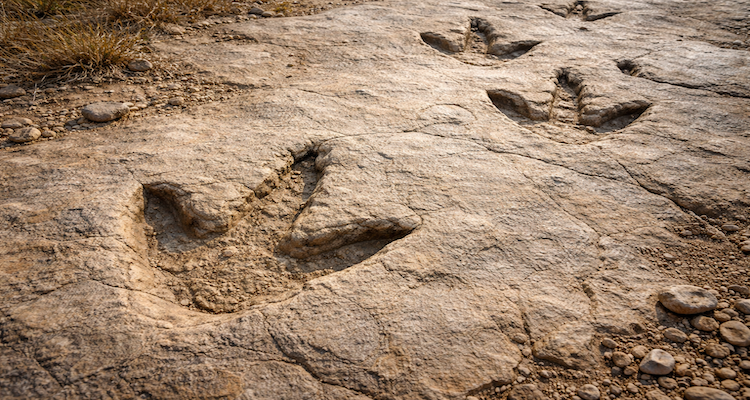
For more than a century, dinosaur footprints have fascinated scientists and the public alike—but identifying exactly which species made them has often been guesswork. Now, a new artificial intelligence driven approach is helping paleontologists move beyond educated hunches toward something closer to forensic certainty.
By analyzing subtle shape patterns in fossilized tracks, researchers say the method could reshape how scientists interpret one of the most abundant, and puzzling types of dinosaur evidence ever found.
Why Dinosaur Footprints Matter
Bones may steal the spotlight in museums, but footprints are the most commonly preserved dinosaur fossils on Earth. They appear in deserts, riverbeds, and ancient coastlines, sometimes as single impressions and sometimes as dense networks of tracks that resemble a prehistoric dance floor.
Unlike bones, footprints capture behavior. They can reveal how fast an animal was moving, whether it traveled alone or in groups, and what kind of environment it lived in. When multiple species’ tracks overlap, they offer a snapshot of entire ecosystems frozen in time.
Yet for all their value, footprints pose a fundamental challenge: linking a track to its maker.
A Long-Standing Scientific Puzzle
Matching footprints to specific dinosaurs has been one of paleontology’s most persistent debates. Tracks vary widely even when made by the same animal, depending on speed, posture, ground conditions, and erosion over millions of years.
According to Gregor Hartmann of Germany’s Helmholtz-Zentrum Berlin, this uncertainty has forced researchers to rely heavily on expert judgment rather than standardized criteria. Hartmann, a physicist by training, led the new study published in Proceedings of the National Academy of Sciences.
The team’s goal was simple but ambitious: create an objective system that could consistently classify footprints based on measurable traits, not intuition.
How Artificial Intelligence Entered the Picture
To achieve that, the researchers turned to machine learning.
They fed an algorithm nearly 2,000 silhouette images of dinosaur footprints, spanning roughly 150 million years of evolutionary history. Many of these tracks had already been confidently linked to certain dinosaur groups by experts, providing a training foundation for the system.
The AI then identified eight key characteristics that explained most of the variation in footprint shapes. These included how weight was distributed across the foot, how widely the toes spread, the position and influence of the heel, and subtle asymmetries between the left and right sides of a track.
Once those features were defined, paleontologists mapped them against known dinosaur types, creating a reference framework that can be used to analyze newly discovered footprints.
Reducing Subjectivity in Paleontology
Hartmann said the strength of the method lies in its consistency. Instead of relying solely on visual comparison or individual expertise, researchers now have a quantitative way to compare tracks across time and geography.
Still, he emphasized that uncertainty remains unavoidable. Footprint shape is influenced not just by anatomy, but also by behavior and environment. A dinosaur walking slowly across soft mud can leave a very different impression than the same animal running across firmer ground.
That variability is exactly why an algorithmic approach can help, by recognizing patterns across thousands of examples rather than focusing on any single track.
Insights From the Dinosaur Family Tree
Steve Brusatte, a paleontologist at the University of Edinburgh and senior author of the study, said the work addresses a problem scientists have wrestled with for generations.
Dinosaurs left behind bones, teeth, eggs, skin impressions, and even fossilized droppings. But footprints often outnumber skeletal remains and appear in places where bones are never found.
In extremely rare cases, a skeleton has been discovered at the end of its own trackway, providing a perfect match. Brusatte noted that he could recall only one such example. In nearly every other case, scientists are left playing detective, comparing fossilized feet to fossilized footprints and hoping they align.
From Chicken-Sized Tracks to Bathtub Impressions
One complication is scale. Dinosaur footprints range dramatically in size, from small three-toed tracks not much bigger than a modern chicken’s to massive sauropod impressions as large as a bathtub.
The AI model accounts for these differences by focusing on proportions and load distribution rather than absolute size. That allows it to compare footprints made by vastly different animals without oversimplifying the data.
A Surprising Bird Connection
One of the most intriguing findings came from a set of seven small, three-toed footprints discovered in South Africa and dated to about 210 million years ago.
The algorithm confirmed earlier expert suspicions that these tracks closely resemble those of modern birds. That’s remarkable because they predate the earliest known bird fossils by roughly 60 million years.
Brusatte cautioned against jumping to conclusions. The tracks do not prove birds existed that early. Instead, they may have been made by unknown dinosaurs closely related to birds, or by unrelated species that happened to evolve similar foot structures.
What the AI result does show, he said, is that the resemblance is real and not just a product of human bias, something scientists now need to explain.
What This Means for Future Discoveries
The new framework won’t replace paleontologists, but it could become a powerful tool alongside traditional methods. By standardizing how footprints are described and compared, it may help resolve long-running debates and make future discoveries easier to interpret.
It also opens the door to reexamining old footprint collections stored in museums worldwide. Tracks that were once considered too ambiguous to classify could gain new significance when analyzed through the algorithm’s lens.
Looking Ahead
As artificial intelligence continues to find its way into the natural sciences, this study highlights its potential to bring clarity to questions once thought unsolvable.
Dinosaur footprints may never tell a perfectly clear story, but with the help of data-driven tools, scientists are finally learning how to read the subtle clues left behind in stone, one ancient step at a time.
(With inputs from Reuters.)
ALSO READ: Kenya’s Pastoral Heartland Buckles Under Relentless Drought
This content is published for informational or entertainment purposes. Facts, opinions, or references may evolve over time, and readers are encouraged to verify details from reliable sources.