





A New ‘Avatar’ Theory Could Unite Two Canons
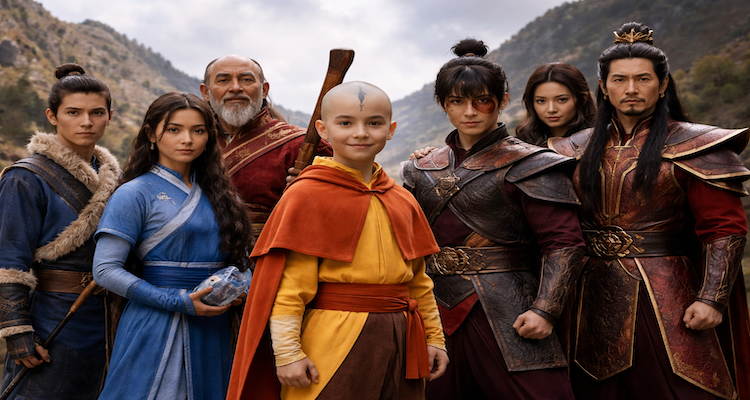
Netflix’s Avatar: The Last Airbender sparked debate the moment it premiered in 2024. While many praised its ambition, longtime fans quickly noticed story changes, tonal shifts, and character adjustments.
Now, a compelling fan theory circulating online proposes a surprisingly elegant solution: what if both versions are canon, just told from different narrators?
A Fandom Divided by Two Versions
Since its debut on Nickelodeon in 2005, Avatar: The Last Airbender has held near-sacred status among animation fans. The original series, created by Michael Dante DiMartino and Bryan Konietzko, blended Eastern philosophy, martial arts-inspired bending, and deeply human storytelling into a three-season epic.
Nearly two decades later, Netflix reimagined the story in live-action, casting Gordon Cormier as Aang, Kiawentiio as Katara, Ian Ousley as Sokka, and Dallas Liu as Prince Zuko. Paul Sun-Hyung Lee portrayed Uncle Iroh, Elizabeth Yu played Azula, and Daniel Dae Kim stepped into the role of Fire Lord Ozai.
While the adaptation earned generally favorable reactions, holding a 62% “Fresh” critic score and a 70% audience approval rating on Rotten Tomatoes at the time of writing, fans quickly pointed out differences in pacing, character development, and event sequencing.
Rather than dismissing these changes as simple adaptation choices, one Reddit user has suggested a more imaginative explanation.
The Perspective Theory That’s Gaining Traction
In a widely discussed post on the r/TheLastAirbender subreddit, user Unfathomably-Shallow proposed that the two versions represent different historical accounts within the world of Avatar itself.
The theory hinges on perspective.
According to the post, the original animated series reflects Katara’s recounting of Aang’s journey, an intimate, emotionally grounded version of events meant for her descendants. Meanwhile, Netflix’s adaptation may mirror an official Fire Nation narrative shaped by Zuko after he became Fire Lord.
It’s an idea that reframes discrepancies as intentional rather than contradictory.
Katara’s Story: Personal, Emotional, Reflective
In the animated series, the story famously begins with Katara and Sokka discovering Aang frozen in an iceberg. It ends with Aang and Katara sharing a kiss after the Fire Nation’s defeat.
The Reddit theory suggests that this framing makes sense if the story originates from Katara’s perspective. Her version would naturally highlight emotional milestones, the Gaang’s personal growth, and vulnerable truths, such as Aang’s early decision to run away from his responsibilities.
From that angle, the animated series becomes more than a chronicle of war. It becomes a generational lesson about courage, accountability, forgiveness, and love.
This interpretation aligns with how the animated series emphasizes character arcs and moral growth. Katara’s voice, compassion, and sense of justice are central throughout the original run.
Zuko’s Version: Political and Strategic
The Netflix adaptation, by contrast, opens with the Air Nomad genocide and leans more heavily into Fire Nation politics and global conflict from the outset.
The Reddit user argues that this could represent Zuko’s rewritten historical account after ascending the throne. As Fire Lord, Zuko would have faced the challenge of reshaping a century of imperial propaganda.
In this imagined scenario, Zuko reframes the Fire Nation’s conquest as a story of reckoning and reparation. His legitimacy as ruler, the theory suggests, would partly depend on restoring the Avatar’s credibility in Fire Nation history.
That could explain why certain events are reordered or why some character portrayals differ in emphasis.
The post also notes that Zuko did not witness the early dynamics between Katara and Sokka before joining the group. As a result, their personalities might appear less layered in a version shaped by his viewpoint.
Reordering Events and Character Emphasis
One noticeable difference in Netflix’s adaptation involves the sequencing of story arcs that unfolded differently in the animated series.
The fan theory proposes that Zuko’s own encounters with Katara, particularly moments that highlighted her strength as a Waterbender, may have influenced how he remembered or recorded events. His firsthand battles against her might lead him to elevate her capabilities in the retelling.
While this interpretation is speculative and entirely unofficial, it has resonated with fans seeking a way to appreciate both adaptations without viewing one as a contradiction of the other.
Importantly, neither Nickelodeon nor Netflix has endorsed this theory.
Critical Reception and Fan Response
Despite initial skepticism leading up to its release, Netflix’s Avatar: The Last Airbender found a solid audience. Viewers praised its production design, fight choreography, and performances, particularly Paul Sun-Hyung Lee’s portrayal of Iroh.
At the same time, critics noted tonal differences from the animated series and questioned some structural changes. The Rotten Tomatoes scores, 62% from critics and 70% from audiences, reflect a mixed but generally positive reception.
Online discussion has remained active, with fans debating casting choices, pacing, and character reinterpretations.
The perspective theory has added a new layer to those conversations, offering a creative framework rather than a defensive one.
Looking Ahead: Season 2 and Toph’s Arrival
Anticipation is building for Season 2, which is expected to premiere later this year.
One of the most anticipated additions is Toph Beifong, portrayed by Miya Cech. The character was a fan favorite in the original series, known for her blunt humor and rebellious streak.
Cech has indicated that her interpretation will differ slightly from the animated version, describing her take as somewhat older and more feminine, while aiming to humanize the character for live-action storytelling.
That approach underscores the broader reality: adaptations evolve. They respond to new mediums, audiences, and storytelling priorities.
Whether viewed as separate continuities or parallel in-universe narratives, the franchise continues to expand.
Why This Theory Matters
At its core, this fan theory reflects something powerful about modern fandom: viewers aren’t just consuming stories, they’re engaging with them critically and creatively.
The idea that both the animated and live-action versions could coexist within a shared fictional history speaks to Avatar’s enduring thematic depth. After all, the series has always grappled with perspective, truth, and the rewriting of history.
In the world of Avatar, history is political. It’s shaped by power, memory, and reconciliation. A narrative told by Katara would feel different from one told by Zuko, and that difference could be meaningful rather than divisive.
The Future of the Avatar Franchise
With Season 2 on the horizon and Netflix signaling long-term plans for the adaptation, the franchise appears poised for continued evolution.
Meanwhile, the animated universe is also expanding through Avatar Studios, ensuring that the original creative lineage remains active.
Rather than forcing a choice between two interpretations, the growing conversation suggests that Avatar: The Last Airbender may be big enough to hold multiple versions of its legend.
In a series built on balance, perhaps that’s fitting.
Continue Exploring:
Crunchyroll Quietly Upgrades Jujutsu Kaisen Season 2
Hunter x Hunter Game Tops Charts in Major Debut
HBO Max Adds 2 Anime Classics in March 2026
This content is published for informational or entertainment purposes. Facts, opinions, or references may evolve over time, and readers are encouraged to verify details from reliable sources.