









U.S. Launches Military Strike on Venezuela, Regional Tensions Escalate
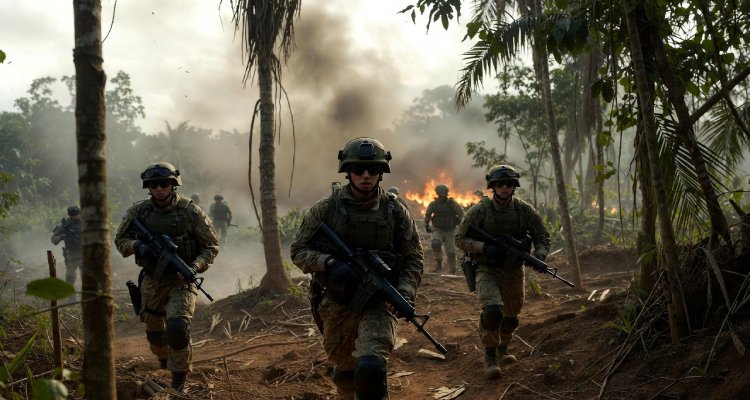
The U.S. launches a military strike on Venezuela, escalating regional tensions and raising fears of wider instability across Latin America and global markets.
Introduction: A Sudden Shock to the Hemisphere
In a dramatic escalation that has sent shockwaves across the Western Hemisphere, the United States has launched a military strike on Venezuela, thrusting the long-simmering standoff between Washington and Caracas into a dangerous new phase. The development has immediately heightened regional anxiety, raised fears of wider instability in Latin America, and reignited global debate over U.S. interventionism in sovereign nations.
While official details remain limited, the announcement alone has been enough to unsettle financial markets, alarm neighboring governments, and trigger urgent diplomatic activity from regional blocs and global powers alike. For a region historically sensitive to foreign military involvement, the strike marks a defining and deeply consequential moment.
Context & Background: A Relationship Marked by Hostility
Relations between the United States and Venezuela have been strained for more than two decades, shaped by ideological clashes, sanctions, and competing visions of governance and regional influence. Since the early 2000s, Washington has accused successive Venezuelan governments of democratic backsliding, human rights violations, and economic mismanagement, while Caracas has consistently portrayed U.S. actions as imperial overreach.
Economic sanctions imposed by the U.S. have severely constrained Venezuela’s oil-dependent economy, contributing to hyperinflation, shortages, and one of the largest migration crises in modern Latin American history. Millions of Venezuelans have fled to neighboring countries, placing immense pressure on regional infrastructure and social systems.
Despite years of diplomatic isolation and economic pressure, direct military confrontation had remained off the table—until now.
Main Developments: What the Strike Signals
The U.S. military strike on Venezuela represents a sharp departure from the strategy of economic and diplomatic containment that has defined Washington’s approach in recent years. Though the scope, targets, and duration of the operation have not been fully disclosed, the action itself signals a recalibration of U.S. policy toward Caracas.
From a strategic standpoint, the strike suggests that U.S. decision-makers may believe previous measures failed to produce desired political or security outcomes. It also underscores growing concern in Washington about broader regional risks, including instability, transnational crime, and the involvement of rival global powers in Venezuela’s affairs.
For Venezuela, the strike is likely to reinforce the government’s long-standing narrative of external aggression, potentially consolidating internal support while escalating nationalist sentiment. At the same time, it raises urgent questions about civilian safety, infrastructure resilience, and the country’s already fragile humanitarian situation.
Expert Insight & Public Reaction: Alarm, Division, and Urgency
International reaction has been swift and deeply divided. Latin American governments have expressed alarm, with several calling for restraint and an immediate return to diplomacy. Regional organizations are reportedly convening emergency discussions, reflecting fears that the conflict could spill across borders.
Security analysts warn that even a limited military action carries outsized risks in a region marked by economic vulnerability and political polarization.
“Any use of force in Venezuela risks triggering unintended consequences far beyond its borders,” noted one regional security analyst, emphasizing the potential for refugee flows, economic disruption, and retaliatory escalation.
Public reaction has been equally polarized. In Venezuela, early responses suggest a mixture of fear, anger, and defiance, while in the United States, the strike has reignited debate over the costs, legality, and long-term effectiveness of military interventions abroad.
Impact & Implications: What Happens Next
The immediate consequences of the U.S. strike are likely to unfold across multiple fronts—political, economic, humanitarian, and geopolitical.
Regionally, neighboring countries may face renewed migration pressures if violence intensifies or essential services are disrupted in Venezuela. Border security, trade routes, and energy markets could all be affected.
Economically, uncertainty surrounding Venezuela’s oil sector—already constrained by sanctions—could ripple through global energy markets, particularly if infrastructure or export capacity is impacted.
Geopolitically, the strike risks drawing in other global actors with strategic interests in Venezuela, potentially transforming a bilateral confrontation into a broader international crisis. Diplomatic maneuvering at the United Nations and other multilateral forums is expected to intensify in the coming days.
Perhaps most critically, the action raises questions about the future of conflict resolution in the region. Whether the strike leads to de-escalation through negotiation or accelerates a cycle of retaliation will depend largely on diplomatic efforts now underway behind closed doors.
Conclusion: A Defining Moment for the Region
The U.S. military strike on Venezuela marks a turning point in hemispheric relations, ending years of uneasy standoff with a decisive—and risky—use of force. As regional tensions escalate, the coming days will be crucial in determining whether this moment becomes a catalyst for renewed diplomacy or the opening chapter of a prolonged crisis.
For Latin America, the stakes could not be higher. Stability, sovereignty, and the well-being of millions now hang in the balance, underscoring the urgent need for restraint, dialogue, and a renewed commitment to peaceful resolution.
The information presented in this article is based on publicly available sources, reports, and factual material available at the time of publication. While efforts are made to ensure accuracy, details may change as new information emerges. The content is provided for general informational purposes only, and readers are advised to verify facts independently where necessary.