









Tourism at the Edge of Time
A deep look at how humanity is redefining exploration through space tourism, time-themed destinations, and future-facing travel experiences in a rapidly changing world.
Introduction (Hook)
The future of travel is no longer measured in miles—it’s measured in moments. As humanity accelerates toward a world shaped by artificial intelligence, space exploration, and climate uncertainty, a new phenomenon is taking shape: tourism at the edge of time. From journeys that simulate the deep past to expeditions that push beyond Earth itself, travelers are increasingly seeking experiences that feel timeless, boundary-breaking, and profoundly transformative.
Once driven by scenery and leisure, travel is now becoming an encounter with the unknown. And at the heart of this shift sits a growing global curiosity: What lies beyond the present moment—and can we ever visit it?
Context & Background
The tourism industry has historically evolved alongside human ambition. Seaside resorts grew out of industrial-era escapes. Air travel emerged with the jet age. Adventure tourism followed globalization. Now, a convergence of technologies—from virtual reality to private spaceflight—is enabling travelers to experience time in entirely new dimensions.
Three major global forces are driving this shift:
- Space Commercialization: Companies like SpaceX, Blue Origin, and Virgin Galactic have turned space tourism from science fiction into an emerging reality.
- Heritage & Deep-Time Tourism: Archaeological sites, ancient observatories, and paleogeological tours are surging in popularity as travelers look to connect with humanity’s earliest footprints.
- Technological Time Simulation: New VR-driven attractions enable people to “step into” historical eras, future scenarios, and reconstructed worlds.
In an era marked by instability—pandemics, climate change, geopolitical shifts—people are increasingly drawn to travel that feels meaningful, expansive, and rooted in a larger story.
Main Developments
Space Tourism Takes Its First Confident Steps
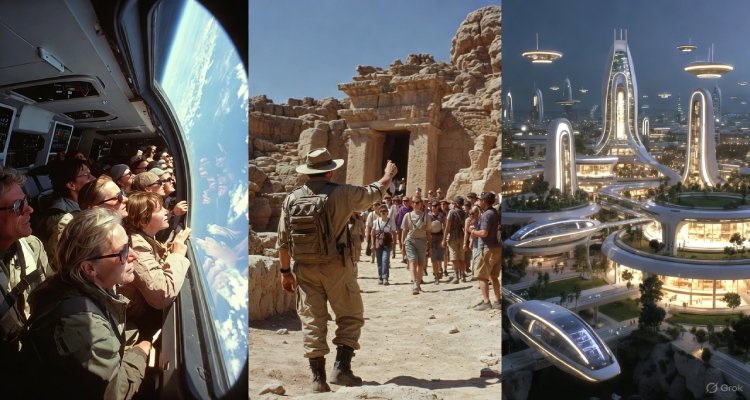
What was once a billionaires’ novelty is quietly moving into early-stage consumer accessibility. Suborbital flights now offer passengers a brief experience of microgravity and a view of Earth’s curvature—a moment described by early participants as “an encounter with eternity.”
Tour operators are already conceptualizing “orbital itineraries,” lunar flyby experiences, and high-altitude stratospheric balloon voyages. These journeys tap directly into humanity’s desire to stand at the edge of the known world.
Traveling Into the Ancient Past
Alongside the push outward is an equally powerful journey inward—into deep time. From fossil-rich landscapes to ancient astronomical sites like Nabta Playa and Göbekli Tepe, travelers are increasingly choosing destinations that echo humanity’s origins.
“Time-depth tourism” is becoming a distinct niche, blending archaeology, anthropology, and immersive storytelling. Many destinations now use mixed reality overlays to reconstruct ancient worlds as they once were, creating an almost time-travel-like experience.
Futurist Destinations Rise Worldwide
Cities like Dubai, Singapore, Seoul, and Tokyo are building attractions inspired not by the past but by what comes next. These include:
- AI-curated museums
- Quantum-tech exhibitions
- Climate-adaptive architecture tours
- Future-of-humanity theme parks
These spaces offer a glimpse into how life may look decades from now, creating a tourism model that bends the traditional timeline.
Expert Insight & Public Reaction
Experts describe this trend as both psychological and technological. According to futurist travel analyst Mira Solan, “People aren’t just seeking places—they’re seeking perspective. The more unpredictable the world becomes, the more we look for experiences that transcend time.”
Travel researchers also note a rise in “existential tourism”—journeys that provoke reflection about humanity’s place in the universe.
Public sentiment echoes this. Travelers across social platforms increasingly share content about:
- stargazing retreats
- ancient ruins
- immersive future simulations
- desert or polar landscapes described as “otherworldly”
The common thread? A desire to feel part of something bigger than everyday life.
Impact & Implications
Cultural and Scientific Benefits
Time-edge tourism is inspiring greater interest in science, archaeology, and space exploration. Museums, research institutions, and space agencies report higher educational engagement as travelers seek context behind their experiences.
Economic Opportunities
Nations with rich geological or archaeological heritage stand to gain significantly. Likewise, tech-driven cities are positioning themselves as future-oriented travel hubs.
Ethical & Environmental Considerations
With innovation comes risk. Space travel raises concerns about emissions and orbital debris. Deep-time destinations must balance tourism with preservation. Future-themed attractions face debates about digital overreach and data privacy.
The challenge ahead is ensuring that exploration doesn’t come at the cost of the very timelines we hope to connect with.
What Happens Next?
Industry experts expect the next decade to bring:
- Affordable suborbital flights
- Climate-resilient “future cities” as tourism hotspots
- Hyper-immersive time-simulation parks
- Cross-border ancient heritage circuits
- AI-designed itineraries tailored to personal themes of time and meaning
Travel, in other words, is becoming a journey through eras—not just across borders.
Conclusion
“Tourism at the edge of time” is more than a trend—it’s a cultural shift. As humans confront a rapidly transforming world, travel is becoming a portal to understanding where we came from, who we are, and what the future might hold.
Whether through ancient ruins, simulated futures, or the velvet black of near space, people are seeking moments that defy the ordinary and make the present feel larger. In an age of disruption, traveling to the edge of time may be our most powerful reminder of humanity’s capacity to dream.
DISCLAIMER :This article is a creative, journalistic interpretation based solely on the provided headline. It does not reference or replicate any existing report, study, or article.